
Episode 51: Nightwardens
Written By Karl White
You could say, a family business is an inheritance of purpose. A trade not merely taught, but embedded in the bloodstream, carried forward like instinct. Each generation refines what the last began, shaping craft into creed. What starts as skill becomes ritual, labor turns to legacy. These families don’t simply learn how to work, they become the work. Their tools, heirlooms. Their habits scripture. And when the trade is that of protection, when the family’s business is about survival, the lessons are carved deeper still. In such bloodlines, duty isn’t a choice, it’s marrow itself, passed like a secret too sacred to die.
The Nightwarden sigil - © 2025 Headless Horseman Productions, LLC
If there is any one ancestry that personified the Nightwarden's the most, it would be The Watkins Family. Stories about their selfless exploits deserve to be passed along, as they've kept the night safe for over two centuries...And while their story isn't a perfect one, it is, above all else, important. This is an abbreviated history...
Robert and Harriet raised their son, Clive, teaching him everything they could about tracking, hunting, and killing vampires…Clive grew into a master hunter. In 1848, at just 23, he inherited command of the Nightwardens, a title passed to him by his father. Under Clive’s leadership, the group migrated west, following an influx of vampire sightings in the ever expanding frontier.
In Indiana, Clive met Levi Coffin, the abolitionist behind the Underground Railroad. Coffin pleaded for help. Night migrations were being ravaged by vampires, runaway slaves disappearing before reaching freedom.
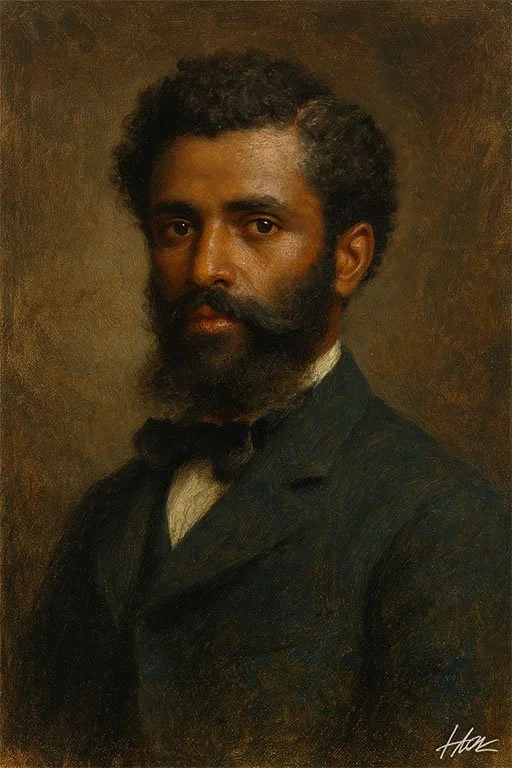
Clive Watkins, 1851 - © 2025 Headless Horseman Productions, LLC
Knowing his father escaped from the bonds of enslavement, joining the abolitionist’s efforts was personal to Clive. So from 1848 to 1865, he and the Nightwardens escorted more than 10,000 runaways to safety. Killing thousands of vampires along the way. It was a war of attrition, cutting off a major food supply for the parasites.
In 1867, just two years after the end of the Civil War, some Nightwardens believed victory had finally been achieved. Of course there was scattered vampire activity in major cities, but in the Great Lakes and the Mississippi River Valley, things had quieted greatly. It seemed that the war with the creatures had finally been won.
The older generation of the ‘Wardens retired. Others set up in major population centers, as watchmen. But Clive had a suspicion something was going on. They had killed many vampires, but nowhere near enough to collapse the species. Robert and Harriett had studied migration patterns for decades. They knew vampires preferred places where they could hunt unencumbered. So Clive followed the push west, into the lawless frontier of Reconstruction America. Knowing where there were people and the wide, wild unknown, there would surely be vampires.
While hunting in northern Wyoming, Clive lived among a Cheyenne tribe. There, he met Komeha'e, who’s name translated to Coyote Woman. They married, and in 1878 welcomed twins, Levi and Mae. The children grew up on the plains, in the mountains, through desert valleys, learning to hunt as naturally as breathing.
Tragically, while the family was tracking a pack of shapeshifters in the Arizona Territory in 1893, they were ambushed. Clive and Komeha'e were slaughtered by the very pack they pursued, led by an individual who went only by the name, Jones. Only 15-years-old at the time, Levi and Mae escaped into the wilderness.
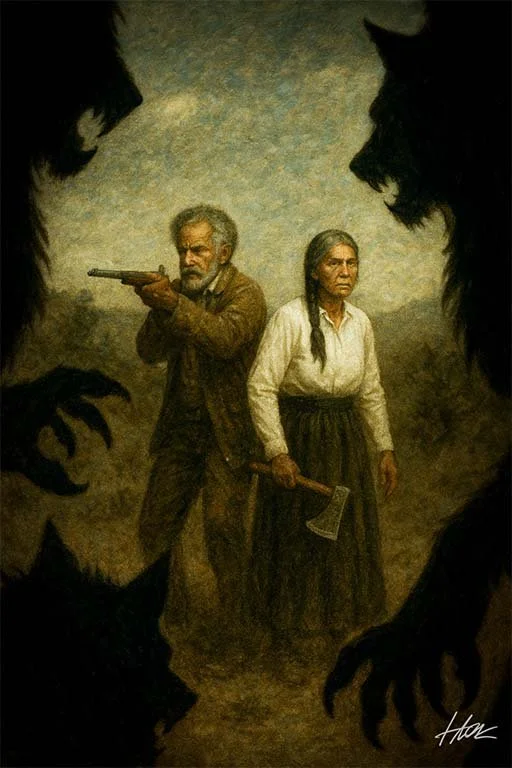
Clive and Komeha’e find trouble in Arizona Territory, 1893 - © 2025 Headless Horseman Productions, LLC
The twins were experienced trackers and hunters, surviving for months, traveling east. They’d eventually arrive where the Mississippi and Ohio Rivers meet in Cairo, Illinois. There they fell in with another family of Nightwardens, led by an old friend of their father’s, Reagan Brown.
Cairo was a bustling port city, a crossroads of commerce and travel, with a large turnover in residence. Prime hunting grounds for vampires. For the better part of the 1890’s, the Browns, along with Levi and Mae, and a couple named Martin and Martha Butcher, kept the city safe and gathered intelligence on the Brood’s passing through. Clive had been right all along, the vampires hadn’t been hunted to extinction, they had altered their patterns of feeding on a large scale.
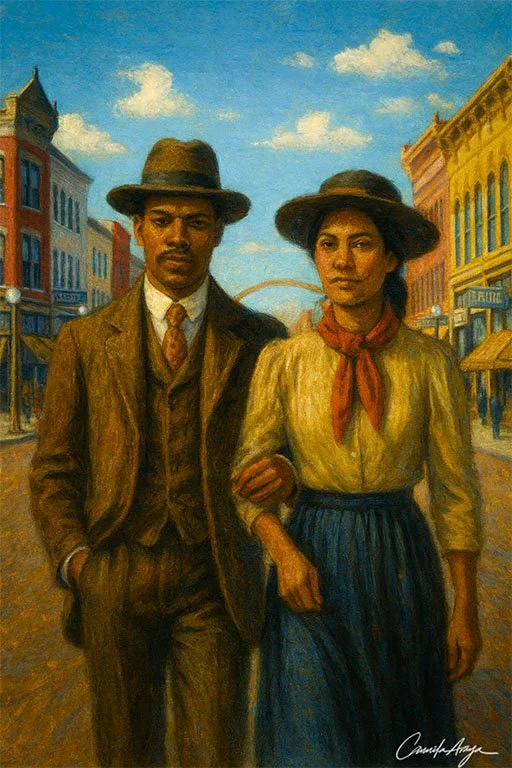
Twins, Levi and Mae Watkins, Cairo, Illinois 1900 - © 2025 Headless Horseman Productions, LLC
But by 1900, Cairo began to boil. Racial tensions erupted after two black men were falsely accused of murdering a white woman, a crime actually committed by a passing vampire. The Nightwardens hunted the creature, hoping to present evidence to exonerate the men. But they were too late. An angry mob stormed the jail and lynched the innocent men. Cairo was changed forever, and no longer safe for the Browns or the Watkins siblings.
Based on information they gathered from the vampire they captured and killed in Cairo, the group headed north through Illinois, first to Champaign and then to Chicago, following concentrated pockets of bloodsuckers. In the Windy City, established Nightwarden cells reported a sudden surge of vampire activity across multiple wards.
Word had it, an older, powerful vampire had arrived with a disciplined Brood that hunted in teams. They'd position themselves in train stations, brazenly using mind-control to lure victims away, mostly travelers arriving to the big city.
At first the Nightwardens assumed the vampires were stockpiling food. But deeper surveillance revealed the truth -- they were building an army. For what purpose, the humans could not yet guess...This was Royce, enacting his plan to strengthen his forces to go after Elizabeth.
The group set up surveillance at Grand Central Station, where the bulk of the kidnappings were taking place. They wanted to track the vampires’ movements in hopes of finding their lair. But one night their cover slipped, and the vampires struck. The Butcher's were killed. Rory Brown, Reagan’s son, died in the attack. And Mae Watkins was taken as well.
In the chaos of the street, Levi got a glimpse of Royce himself, guiding Mae away under mind-control. Levi tried to give chase, but a busy crowd swallowed them. The vampire made off with his sister.
LEVI: (yells) MAE!!!
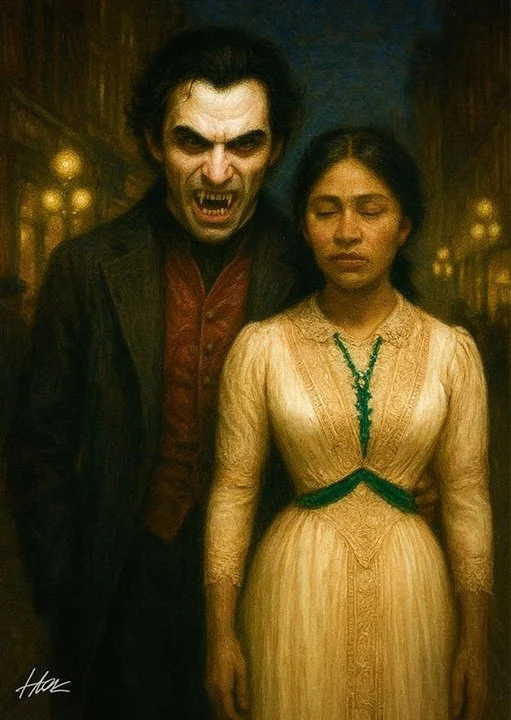
Royce kidnaps Mae - © 2025 Headless Horseman Productions, LLC
Mae’s body was found the next morning on the shores of Lake Michigan. Royce, was sending a message, a warning, a declaration to the Nightwardens.
Levi, consumed with guilt, mercilessly hunted Royce’s Brood across the Midwest, killing dozens...but Royce had vanished. He had come to America on a mission, and no human would stand in the way of achieving his objective.
War had broken out among vampire-kind. They were preoccupied with battles, infighting, skirmishes between Elizabeth’s forces and the alliance of Victor Monfret and Royce. It created a distraction, an opening for the Nightwardens. The chaos of war gave them room to thin the parasite numbers without concentrated retaliation.
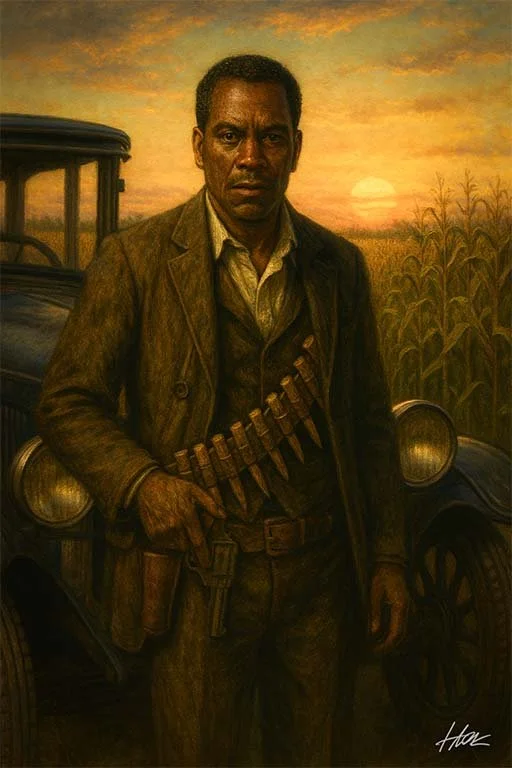
Levi Watkins on the hunt for Royce, 1925 - © 2025 Headless Horseman Productions, LLC
But by 1925, Levi had broken off from the groups efforts, fruitlessly searching for Royce. It consumed his life. He hunted most nights. Didn’t take care of himself. His health, both mental and physical suffered greatly. One night, after months of careful surveillance, Levi cornered one of Royce’s lieutenants in a barn outside of Bloomington, Illinois. But in his fatigued state, the vampire got the drop on him...moments away from ending Levi's life, the farm’s owner rushed in and finished the creature herself.
Her name was Rose Helms. She was a worldly woman in her forties, Levi’s age, who had returned home to run her family’s farm after her father’s passing. Levi wanted to know how he could repay Rose for saving his life...what she needed most was help tending to the failing farm. So he put his hunt on pause and pitched in. Learning his story, his unique lineage, his sister’s murder, his life focused by vengeance, Rose made Levi a proposal...To stop running, marry her, and start a family. She knew a little something about family businesses, and the promises made to kin. What she was giving him was a chance to pass his legacy on before it was too late.
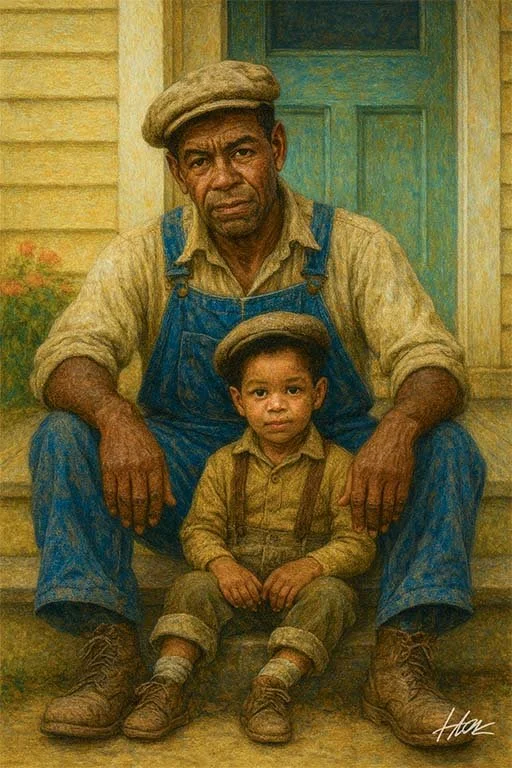
Levi with young Bernard, 1933 - © 2025 Headless Horseman Productions, LLC
Their only child, a son, Bernard, was born in 1929. Levi officially retired as a vampire-hunter, but raised his boy in the ways of the Nightwarden’s. Bernard's singular inherited focus would be, finish what Levi could not -- find Royce, and kill him.
In 1948, at the ripe young age of 19, the well-trained Bernard left home. He was a prodigy, cold-blooded, strategic, fearless, and fluent in the parasite mind. He became a weapon, born to kill, forged from generations of purpose. Using the streets, he would gather intel on the warring sides. And he was so skilled as a hunter, his name would actually be feared in blood-sucker circles. But Bernard’s most lasting legacy would not be the vampires he killed, but in what he would eventually, reluctantly become -- a father.
TO BE CONTINUED…