
Episode 33: Nature of Man
Written By Karl White
Sailing along westerly winds, the beauty of night unfurled like a shimmery satin banner across the sea. Rah couldn’t help but look out in awe at the astonishing creations on this Earth, it quieted him. The dark water breathing against his vessel, silver backs of creatures stitching through the waves, a sky so starred it felt alive. For the first time in his long life, his mind and heart were at ease.
Reaching his destination, the crude sails of his boat held long enough to make it. Land rose pale out of the dark. The white sand of a southeastern shore on a continent the world had not yet named. Rah beached the craft and moved inland by moonlight, taking his time through dense jungles, searching for life. He found only small, nomadic bands, wary eyes at the edge of firelight, hands quick to stone and spear at the stranger who walked by night.
He didn’t press. He watched. He was only interested in being welcomed into a fold instead of forcing his way in. Even attempting to use his telepathy for communication proved difficult as it would unsettle them, hearing the strange voice in their heads. So he kept his distance and moved on, honoring the organization of the budding pockets the humans were making in the wild.
Rah never wanted to come across as a threat or induce violence. Although he knew conflict and brutality existed among man, his hope for this world was to preserve the goodness he saw, as long as he could.
By 6500 BCE, Rah had long settled near the Amazon basin in what is now present-day Peru. There he mingled with a thriving civilization of the early Quechuas people. His goal, to teach them naturally occurring, universal things, such as math and science. He’d show them how to track the seasons, maximizing opportunities for farming. He wanted to watch the population flourish and knew his guidance could provide their greatest chance for survival.
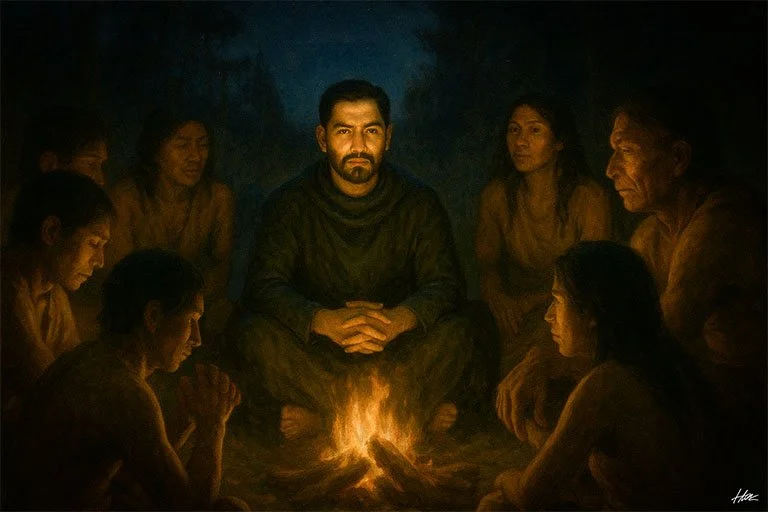
Rah amongst the Quechua - © 2025 Headless Horseman Productions, LLC
Rah also began making a Brood. Ambassadors to spread the word about the good he wanted to achieve. His Underlings would stand beside humans as advisers, never anything more. Rah would choose the brightest, the most curious humans to pass his blood to. Always offering them the choice. He would show them what the change meant, life pulled from the human river to become something else. Some declined. But most accepted, seeing in Rah a supreme being and, in his blood, a way to carry the same kind of power.
Rah treated his Underlings as equals, and they answered with loyalty. Their first tenet would be to ignore their bloodlust towards humankind, instead adopting Rah’s own non-violent feeding habits. Together they formed a quiet covenant, Vampires in service to the living, knowing they were once part of the evolving culture, but now stewards of it.
But the idyllic selection that built Rah’s order would soon need revision. As an anomaly rose within the tidy Brood. An accomplished hunter from the tribe, Wayra, was offered Rah’s blood and accepted. At first, he was exemplary, a model of restraint. Yet metamorphosis not only remakes the flesh. The mind must learn its new skin. To live by night alone, to feed on animal blood too thin for a warrior’s pulse, these were chains Wayra could not make peace with. Something in him gave way. He snapped, going on a murderous rampage, feasting on flesh of friends and family.
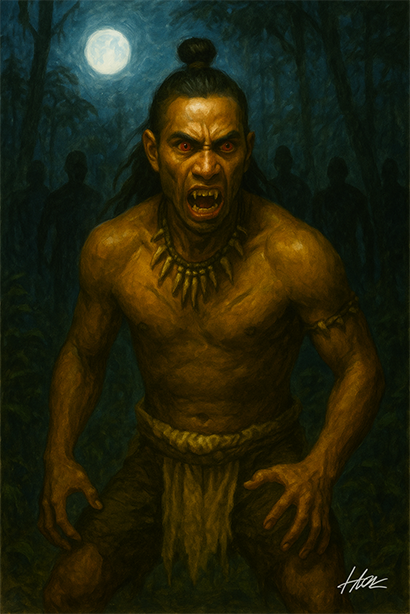
The warrior, Wayra, hunted by Rah’s Brood - © 2025 Headless Horseman Productions, LLC
Rah couldn’t bring himself to put Wayra down, but something had to be done before a rampaging Vampire shattered the trust that had been so carefully built with the humans. He sent his most trusted Underlings to hunt him, and they ended it swiftly, mercifully, an example made. The Quechua read the act as a sign from the gods -- that to set the balance right, a sacrifice must be offered.
Humans were perceptive with any aspects of a Vampire’s life -- especially the consumption of blood. But little did Rah realize, the rituals that would be translated from his actions also began filtering to other civilizations throughout the Amazon. Practiced by rulers and priests in even the furthest villages. The interpretations would be diluted, becoming barbarous. The spilling, consumption, even offering of blood as ritual would carry on for generations.
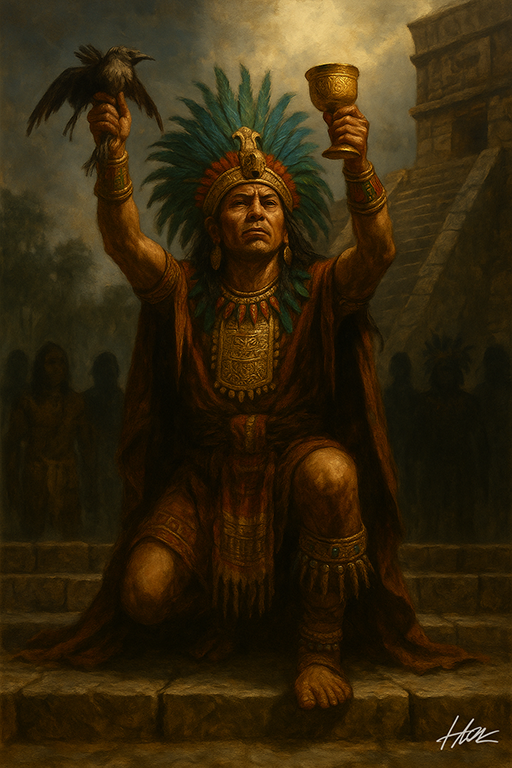
A ritual in the name of Rah - © 2025 Headless Horseman Productions, LLC
By 500 BCE, people were on the move, migrating, expanding, seeding new lands. Rah’s influence over the continent had grown by leaps and bounds. Hunters and farmers had been educated for thousands of years and were reaping the benefits of what Rah had taught. Thought ran freer. Lives ran fuller.
Rah and his growing Brood removed themselves as permanent fixtures in the villages and took to the rivers, poling up the Amazon Basin to watch how far the teachings had spread. Along the way he heard of a people far to the north, the Olmecs, who were developing complex equations based on the mathematical formulas he’d seeded in the south. Eager to see if the stories held, Rah turned toward Mesoamerica.
The Olmecs had developed a highly intelligent society. Stonecraft grew precise, and the first soft metals were coaxed from ore for tools and ritual. They bent land to yield, raised colossal monuments to their gods, his among them. They also looked to the sky, tracking the moon, calculating the alignment of stars, preparing an advanced calendar system, convinced they could predict future events.
Rah and his Brood were welcomed with open arms. The Olmecs were exalted to have one of their gods ascend to further his teachings. Tirelessly working with these forward-thinking humans, Rah schooled them in the universal sciences, and the result would see one of the most advanced civilizations in history, prosper. Rah firmly believed the Olmecs would rule over the world.
But as centuries gave way, Rah, who had put so much faith in the advancement of man, also witness the fatal flaws in humanity. No amount of knowledge could account for egotism, greed, or man’s animalistic nature. Rah watched the Olmecs, who built an empire with an eye forward, fall by way of climate change they couldn’t foresee. Fields failed, food supplies dwindeled, the empire dying out.
He witnessed the Teotihuacán, who mastered farming and in turn experienced an explosion in population, toppled by opposing civilizations because they ignored fortification. He even saw the Mayans and Aztecs, who were both strong in military, destroyed by the even more devious and barbaric European cultures who invaded the continent with the intention of marauding the cultures of their gold and riches.
The Spaniards’ violence gutted him. It was the old story in new clothes, too near his own, peaceful worlds bled for greed. Rah’s dream, shepherding a peaceful rise, shook under the weight of what humans would not refuse -- their own nature.
And still, he did not turn from his work. He’d seen pockets of harmony, sparks that held. He chose persistence, one life, then the next, hoping odds could be defied.
But the final straw came in 1519, as Rah watched in horror, as Conquistador, Hernán Cortés with nearly 1000 neighboring Tlaxcala warriors, entered the Aztec city of Cholula -- slaughtering tens of thousands and reducing the city to ash. Rah considered stepping in, to stop the butchering with violence of his own, but he had sworn himself to peace.
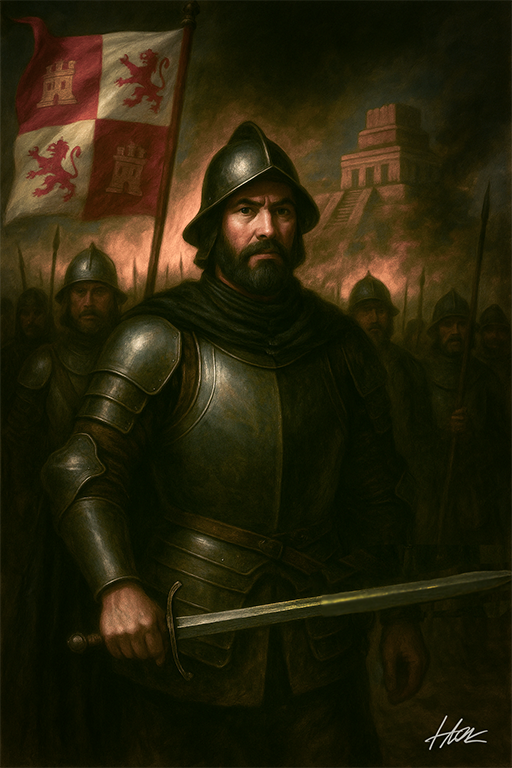
Cortés enters Cholula, 1519 - © 2025 Headless Horseman Productions, LLC
It was a pivotal turning point, one in which Rah ultimately lost his faith in humanity. The brutality of the Spaniards pushed him and his ever-growing Brood from the continent. They’d hop around the Caribbean, searching for safety and purpose.
By 1559, Rah set his family in Haiti. He laid down the work of befriending humankind, formally retiring from his honorable experiment. In its place, he turned inward. Creating a utopia for his Brood, teaching those closest how to live and prosper in peace. If they grew strong enough, perhaps, one day, Vampires could step from the dark and intercede in mankind’s ruinous appetites.
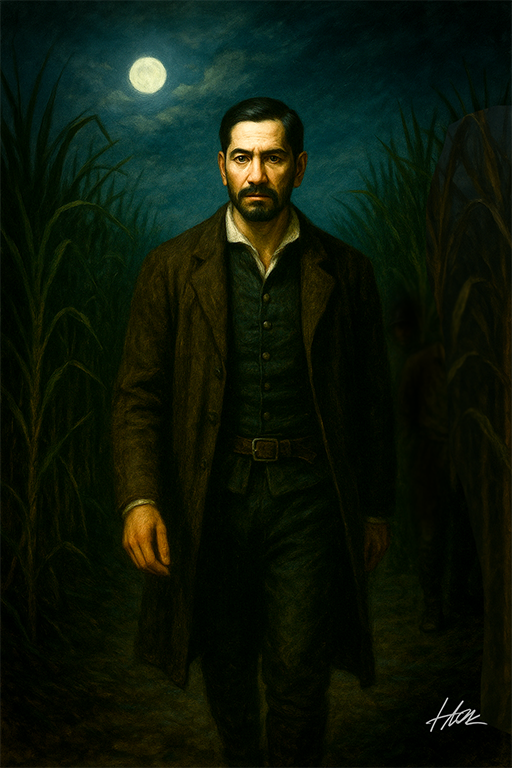
Rah in Haiti - © 2025 Headless Horseman Productions, LLC
But this new endeavor could only be possible without interruption or sway from the outside world. Rah acquired vast lands and built a powerful coffee and sugar plantation. Amassing wealth great enough to draw attention away by seeming ordinary. He imposed one hard law on his Brood -- no contact with humans. Only he would traffic with the corruptible.
The once-outgoing teacher became an introverted patriarch, pouring knowledge into his “children,” sealing them off from the tide outside. It was a choice born of grief and hope. But a road that would eventually lead Rah to his own destruction, leaving his Brood to follow a much darker soul than he.
TO BE CONTINUED…