
Episode 69: King Nothing
Written By Karl White
He called himself King, though there was no empire to answer the claim. No authority beyond his circle of followers who mistook certainty for power. He spoke as if the world bent towards him, declaring dominion over lands he could not hold, and futures he could not shape. And yet, in the emptiness of everything, this ruler of naught remained unshaken. Sustained only by the echo of his own voice and the fragile loyalty of those willing to stand beneath it.
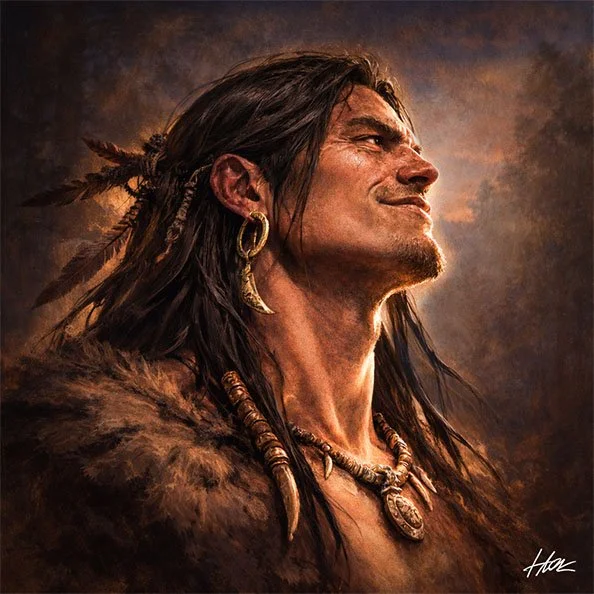
Cuetlachtli, the king of nothing - © 2026 Headless Horseman Productions, LLC
In the mid-1800s, Native American nations were forced from their ancestral lands as the United States government pursued expansion under the authority of the Indian Removal Act. Framed as policy and progress, the removals were carried out through coercion, broken treaties, and military force, pushing entire Indigenous communities westward to make way for settlers, farms, and rail lines. Families were driven from homelands they’d lived on for generations, sent across unfamiliar terrain under brutal conditions, where hunger, disease, and exhaustion claimed innumerable lives. Within that century alone, the aftermath was unmistakable, cultures were forever fractured, nations weakened, and a deep wound cut into the fabric of the land, one that would continue to shape the American frontier long after the marches ended.
Cuetlachtli and his Wonvertu soldiers were no exception. The pack was forced from their mountain stronghold high in the Rocky Mountains. After the death of French explorer and trapper Pierre Marat in 1765, a target was put on the King of the Wolves. With stories of man-beasts luring people to their deaths, something had to be done. But horrors of the legends and lore kept people away. It wasn’t until after the Lewis and Clark expedition officially opened the west, and whispers of gold being up in them thar hills, that real action was taken. As the promise of profit creates motion faster than just about anything.
In 1841, a well-armed militia from Fort Laramie made plans to head into the mountains and face whatever threat was really there -- man or monster. From a distance, they watched Cuetlachtli’s macabre outpost and mistook it for a renegade band of Indians. But when the mountain wind shifted, the Wonvertu caught the scent of trouble. And in a blink, they morphed into their animal forms, charging headlong into an all-out attack. Horrified to witness the werewolves transformation, but having heard all the tales about the murderous group, the heavily armed humans came prepared with enough guns and ammo, including bullets of silver, dynamite, and two small cannons.
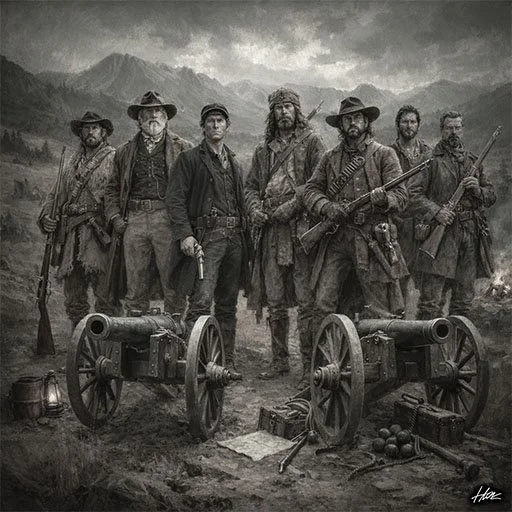
Fort Laramie Militia, 1841 - © 2026 Headless Horseman Productions, LLC
The clash that followed was brief, brutal...and wildly unbalanced. Gunfire cracked against stone, the cannons thundered, and the mountains answered with echoes that swallowed the screams. The werewolves fought like cornered spirits, tearing through ranks with tooth and claw, defending the last inch of ground they believed was theirs. But iron and fire proved stronger, booming dynamite shattered rock and refuge alike, smoke choked the air where howls once ruled. When the noise finally faded, the sanctuary lay broken. Cuetlachtli and what remained of his pack, scattered into the high wilderness. The mountains stood silent once more.
After the defeat, and retreating to the plains, the pack was forced to disguise themselves as friendly Navajo and Osage, seeking help after being displaced by aggressors... But it was all a ruse, a continuation of their wolves in sheep’s clothing strategy. They’d move closer to other tribes, establish good relations during migration, then kidnap women and children, to feed on later.
For over 40 years, Cuetlachtli and his pack terrorized displaced tribes, gaining a reputation as the evil Yee Naaldlooshii, a clan of witches that could shape-shift from men to animals.
In 1877, the king and his followers were hunting with reckless abandon in the Northern Plains. As dozens of reports of the violent, murderous tribe flooded the local military outpost, the United States Cavalry was dispatched to capture or kill the band.
For two years the Army tracked the elusive clan, believing they were chasing ghosts -- never fully grasping what Cuetlachtli and the Wonvertu truly were.
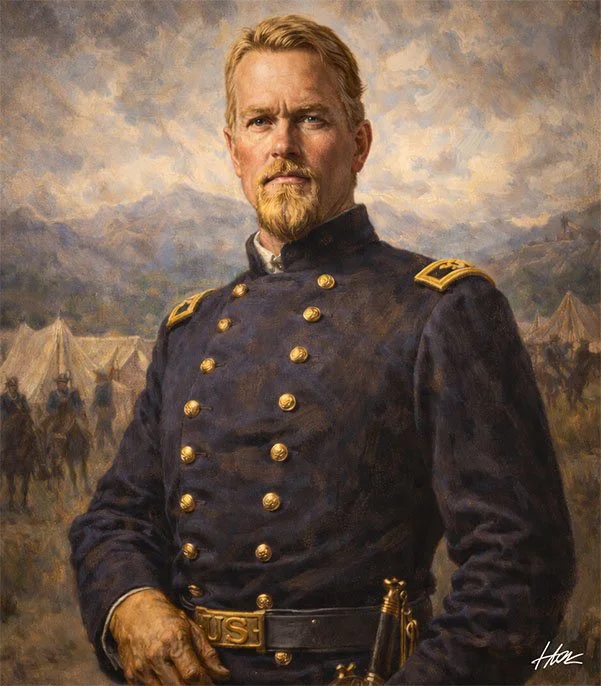
Colonel Robert Quick - © 2026 Headless Horseman Productions, LLC
Then in 1879, while in southern Wyoming, the Cavalry, led by Colonel Robert Quick, tracked the murderous pack to the edge of the Medicine Bow Mountains. More than three hundred mounted soldiers rode into the jaws of death as the pack transformed into werewolves, tearing them down. Cuetlachtli and the Wonvertu fled again to live another day. But the world around them was rapidly changing, closing in tighter than ever before.
Manifest Destiny was the belief that the land itself was waiting, empty, to be claimed by those who arrived with hope and conviction. The world was becoming modernized at a rate that ravaged Native American culture. What was left of peaceful tribes were pushed further, onto barren, unwanted lands. It was a harsh truth, but one that could not be ignored, not even by a would-be king.
At the turn of the century, Cuetlachtli, representing himself as the chief of a small band of Blackfoot, and not using his given name, petitioned the Office of Indian Affairs for a parcel of land made available by the Dawes Act of 1887. The land was granted to him under the condition that they remain “civilized”, surrender tribal status, farm the land, and become U.S. Citizens. It was a necessary move and another example of Cuetlachtli pretending to be something he wasn’t.
The once-powerful had been downgraded yet again. Reduced to the capacity of a commoner. And so Cuetlachtli and the remaining members of the Wonvertu lived on a commune outside of Boise, Idaho, appearing to tend the land and become genteel.
But the troubles for Cuetlachtli wouldn’t go away, only evolve. Staying in one place provided stability, but with mouths to feed, and a deep hunger to satisfy, their method for survival would have to change.
Secretly the group would use the land to build bunkers affectionately called the Wolf’s Den, where they would feed on kidnap victims captured throughout the Northwest. But their idyllic existence would be challenged several times as putting down roots had its disadvantages.
The landscape of the West continued to transform. Forced onto reservations, Indigenous people sacrificed so much to remain safe, but to the industrialist powers, it wasn’t enough. Some tribes, although granted lands by the government, were forced to move again to smaller parcels, if the land they occupied was deemed “valuable”.
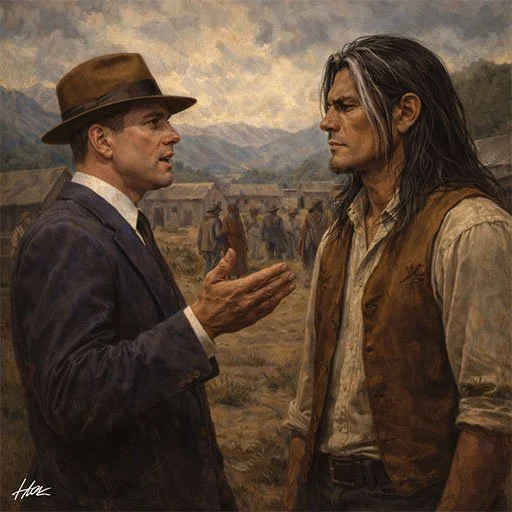
John Hensel tries to get his way - © 2026 Headless Horseman Productions, LLC
By the 1930s, Idaho was in the midst of a gold rush and with it came greedy hands. A demanding Land-Barron named, John Hensel, made a very deadly mistake when he became convinced Cuetlachtli and his tribe were sitting on prime, gold ridden real estate. Hensel came sniffing around...
HENSEL: Doesn’t seem your land is growing much. Your fields are thin.
CUETLACHTLI: It’s enough to feed ourselves.
HENSEL: What if I offer a way out? Sixty-cents on every dollar your acreage is worth. That’s a fine deal for an Injun.
CUETLACHTLI: Money doesn’t interest us.
HENSEL: I’m trying to be Christianly, but I don’t need your cooperation. I can get you outta here one way or another.
Hensel threatened to take his case to court. But before he could set the wheels in motion to seize the land, he, his entire family, and his attorney, would go missing. No trace was ever found. And no one suspected the graying Indian farmer or his people -- But it served as further proof Cuetlachtli and his Wonvertu warriors would go to any length to keep themselves safe, as their den had become something of a final stand.
TO BE CONTINUED…