
Episode 96: Anarchy
Written By Karl White
As the second half of the 20th-Century unfolded, the world grew more watchful, more cautious, no longer dismissive of threats simply because they sounded impossible. Danger was no longer defined by what could be seen, but by what lingered just beyond the edge of complacency. It was an age where vigilance replaced innocence, and the cost of being wrong became something too great to ignore.
Long after Dr. Ichikawa had been put to death, Larry Halford and Roy Starling were more committed than ever to their mission. The pursuit of Dr. Bellian Vale, wasn’t a manhunt in the traditional sense, but a search for understanding, for the truth behind why the virus existed at all. Yet the entire endeavor, including Vale’s history and whereabouts remained elusive. Through the 1960s and 70s, Halford and Starling could never get in front of their quarry. And needing to know what kind of evil Vale really was became something of an obsession.
Stopping the plague had become their life’s work. The constant chase consumed them both, leaving little room for anything else. Relationships faded, opportunities passed, and the idea of building normal lives felt like a risk neither man was willing to take. Bringing new life into a world they believed stood perpetually on the brink of collapse felt, like a losing wager.

Fred Pike having a catch with Uncle Larry - © 2026 Headless Horseman Productions, LLC
In rare moments they allowed themselves something resembling normalcy, finding it in the company of Halford’s sister, Barb Pike, and her son, Frederick.
Fred grew up in the orbit of men who were never quite present, as his father was a CIA operations officer who spent most of his life under deep cover in foreign countries. So when Larry or Roy found themselves in DC, they’d fill the role of father...not as replacements, but as steady, capable figures who offered something resembling stability.
As he grew older, Fred followed a path not unlike theirs, entering government service, and quickly establishing himself as a rising asset in the CIA. Halford watched his nephew with a mixture of pride and restraint. He never wanted Fred pulled into the work he and Starling had taken on, never wanting him exposed to the truths they carried. But even then, the question lingered in the back of Larry’s mind, if not Fred, then who? Because the fight they were in wasn’t ending, only evolving.

Roy Starling at the Sedna outpost - © 2026 Headless Horseman Productions, LLC
By the mid-1970s, time began to take its toll. Roy suffered a heart attack, ending his ability to remain in the field. Rather than retire, he accepted an assignment on the remote CIA outpost of Sedna, a small, unmarked island off the coast of Alaska. Once used during the war as a wilderness training facility, Sedna had been repurposed, officially functioning as an observation post. But it secretly served as a storage site for retired black projects -- Programs too dangerous to destroy outright, but too politically sensitive to acknowledge.
Among them was S.H.E.D., the Special Hazardous Environmental Directive, which housed remnants of unused weaponized strains of the zombie plague including Project Easter, and Dr. Wahl’s Doomsday variant. Starling accepted his duty, unaware of the full scope of what he had been placed in charge of guarding.
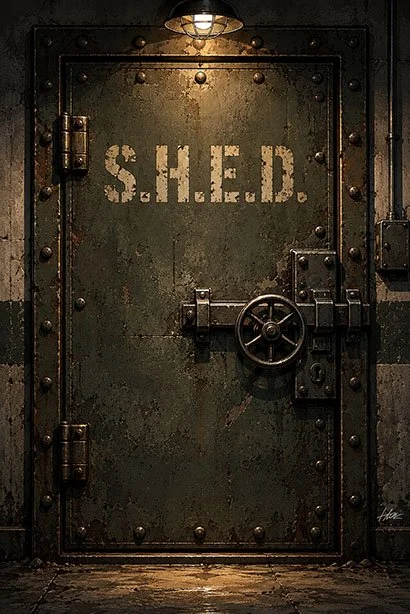
Black projects storage on Sedna - © 2026 Headless Horseman Productions, LLC
With Starling removed from the hunt, Halford was again forced to confront the limits of his own reach. But his attention was soon drawn to a young researcher working in an adjacent program focused on communicable disease, Dr. Mei Lin Zhou. The daughter of Chinese immigrants, she was raised in the United States but shaped by a history her family rarely shared. Her grandfather disappeared in northern China during the years of Japanese occupation, believed lost in the chaos of war. But the reality was much darker, as his name appeared in Ichikawa’s records as an early test subject.
Mei Lin didn’t speak of it openly, but it lived in her work. When Halford met her, he recognized it immediately, as they shared the same drive for the same answers. They hit it off quickly, and in her he saw someone capable and willing to carry his fight forward.
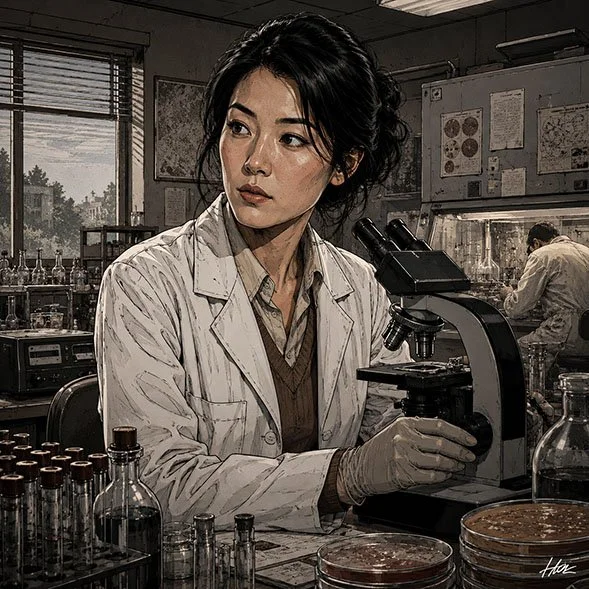
The next generation of plague hunters, Dr. Mei Lin Zhou - © 2026 Headless Horseman Productions, LLC
As Halford turned his focus back toward Bellian Vale, Mei Lin was tasked with tracing the twisted path Dr. Ichikawa’s work had taken. Through intelligence networks, she was pointed to the Middle East, where rumors were surfacing of a rising dictator building a covert biological weapons program.
In 1978, that same thread intersected with an entirely different story. United States Senator Stanton Wheeler traveled to Darvashir on a diplomatic mission aimed at reinforcing America’s standing with the nation’s oil interests. Accompanying him was his fourteen-year-old son, Winchell, who preferred simply going by Win.
The trip was meant to serve two purposes, political on the surface, personal beneath it. Stanton hoped to reconnect with a son he barely understood. A boy whose intelligence was matched only by his tendency toward trouble. Win had been expelled from school after detonating a crude explosive on campus, the latest in a pattern of escalating behavior that followed him from one private school to another. The trip, in part, was meant to reset that trajectory.
While his father attended meetings with Farouk Dastan, Win was left to his own devices, slipping away from his security detail during a sightseeing excursion on the outskirts of Vashkandar.
What began as idle wandering became something else. He saw a version of the world that stood in stark contrast to his own, wealth and excess standing beside scarcity and survival, and the imbalance struck him deeply.
Further out, Win stumbled upon an abandoned facility. One of the many temporary sites used by Dastan and Vale, relocating their biological weapons program frequently to avoid detection.
Inside, Win found remnants of a hastily vacated lab and to his surprise, several, still animated monkeys infected with the virus, rotting in cages. Fascinated, he continued snooping, coming across a vial of the Crimson Virus. A whisper, a dark voice compelled him to take it, and so he did. He wouldn’t tell anyone what he’d found, especially his father...intending to learn more about the decaying sickness when he got home.
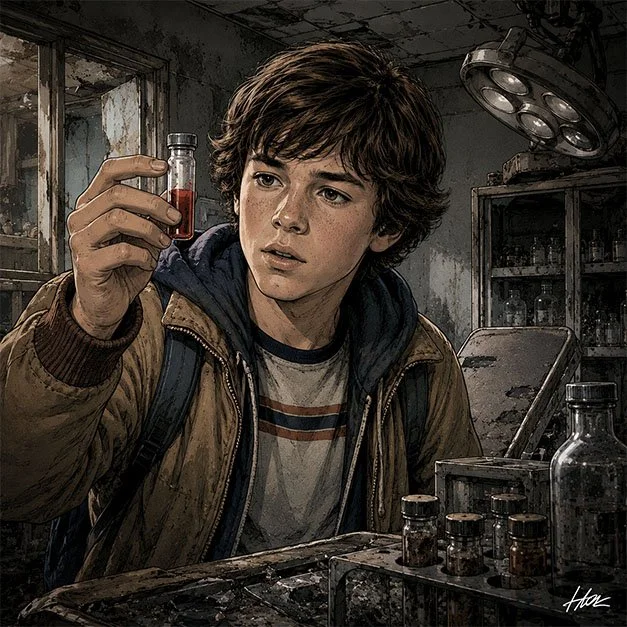
Win Wheeler discovers the Crimson virus - © 2026 Headless Horseman Productions, LLC
Back in Seattle, Win started at a new school, with his parents wondering not if, but when trouble would find him again. But to their surprise Win seem changed for the better. He focused on school, avoided trouble, and applied himself in ways he never had before. But it wasn’t growth, it was fixation.
Win immersed himself in the study of disease, pathology, and the mechanics of infection. At the library, he combed through records of past plagues, discovering the secret tucked away in his bedroom was most likely the Black Wind of Death. At school, he pestered his biology teacher with increasingly specific questions about tissue analysis and disease interaction. At home, using makeshift protective equipment and a microscope purchased from a thrift shop, he began experimenting, first in theory, then in practice. His work escalated quickly. Using brain tissue sourced under the guise of a school project, he began testing the virus, approaching it with a cold detachment that outpaced his age.
Then, came testing the virus on a living subject. Win lured a transient to an abandoned warehouse, offering him a meal laced with trace amounts of the virus. Within hours, the man fell into delirium, taking a haggard last breath, then rising as a zombie. The result was immediate, violent, and nearly fatal for Win. He escaped, but not unchanged. It was a threshold crossed, and one he could never come back from.
By 1980, Win had moved beyond simple rebellion. Drawn to the growing culture of punk and anti-establishment ideology, he embraced chaos as a philosophy. He believed society had become hollow, consumed by excess and illusion, and he sought to tear it down, even as he continued to live comfortably within it.
He gathered a group of like-minded followers, disaffected and restless, drawn to his confidence and intensity. Most were affluent teens from the ‘burbs, unchallenged, but eager for something more destructive. They formed a group, operating under a name that distanced their actions from their identities, calling themselves the Dam Min Dami, abbreviated DMD, which was Arabic for Blood of My Blood.
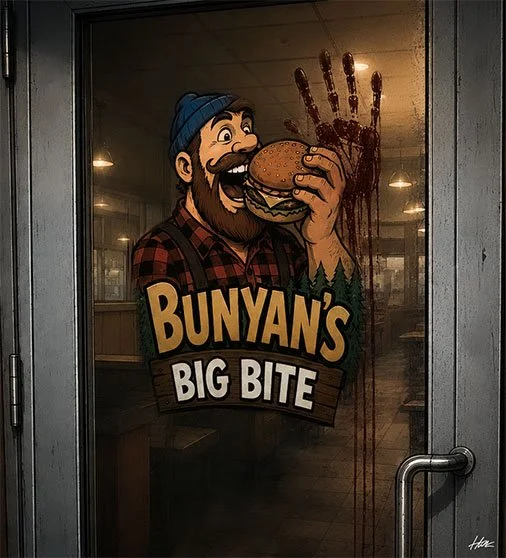
Aftermath of an outbreak - © 2026 Headless Horseman Productions, LLC
Their first major act came in the spring of 1981. Using a modified bacterial compound derived from the Crimson Virus, they contaminated food at a regional fast-food chain, Bunyan’s Big Bite, a lumberjack-themed restaurant known for its oversized portions and crowded lines.
The result was immediate and catastrophic within the confined environment of the restaurant. But the outbreak didn’t unfold as they’d expected. Authorities responded swiftly. The incident was contained. The narrative suppressed. And the story of a chaotic zombie outbreak never reached the public.
But among those called to the scene, within the tightly controlled containment zone, Dr. Mei Lin Zhou recognized something others didn’t -- this wasn’t random or accidental.
What troubled her most was the food contamination, acting as a quick delivery system. It was a bold attempt and whoever was responsible, though crude in their method, nearly pulled off something much larger.
TO BE CONTINUED…