
Episode 60: King of the Wolves
Written By Karl White
Some legends start with a bang, others a whisper...and some yet, with a cry of a newborn baby. On a cold winters night in 610, in the emergent Mississippian culture in what would become the Cahokia settlement, a special child was born. After the sun set, there was a commotion, screams, howls...a rampaging werewolf cut through the village as a strange tribe no one had ever seen before, was passing through.
In the aftermath, an abandoned infant was discovered. Word spread through the settlement the baby was born from a skinwalker. He was given the name Cuetlachtli, which quite literally meant, “Wolf”. Despite fear and superstition, the Cahokian people took the child in, adopting him as their own, fully aware that he was cursed as a Child of Nature.
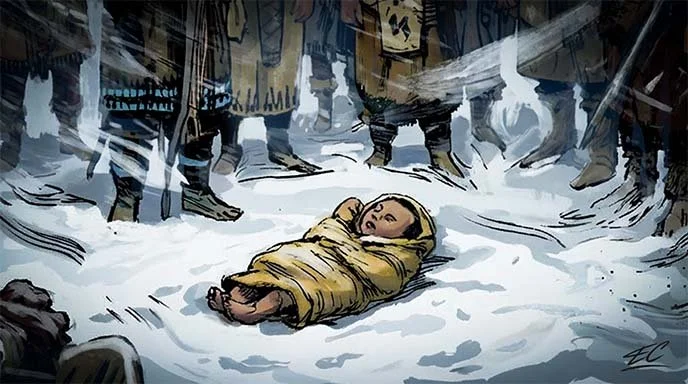
Cuetlachtli, born and abandoned - © 2026 Headless Horseman Productions, LLC
Cuetlachtli aged unnaturally. Where his surrogate family grew old, he barely changed, growing a year for every twenty of theirs. Generations passed before he reached maturity. Nearly one hundred and eighty years after his birth, the curse finally revealed itself, as his first change burst violently forth. He was both revered and feared, believed to be a great spirit given flesh. To his people, his existence was bound to prophecy, told he was chosen as “The Light of the World”.
He was raised gently, cautiously, taught that to defy nature or disrupt his destined greatness would invite catastrophe. Cuetlachtli lived as he pleased, answered to no one, was worshipped without question. It was an idyllic existence, but one that fostered a fragile and overinflated sense of self. Told from birth how special he was, Cuetlachtli grew spoiled, temperamental, and deeply self-important.
But in the year 994, everything was taken from him. While hunting alone in his werewolf form, a powerful tornado tore through the settlement, killing every remaining member of his tribe. Cuetlachtli returned the next morning to devastation. No survivors. Suddenly alone. The abandonment in his infancy, centuries of watching loved ones age and die, and the total eradication of his people shattered him psychologically.
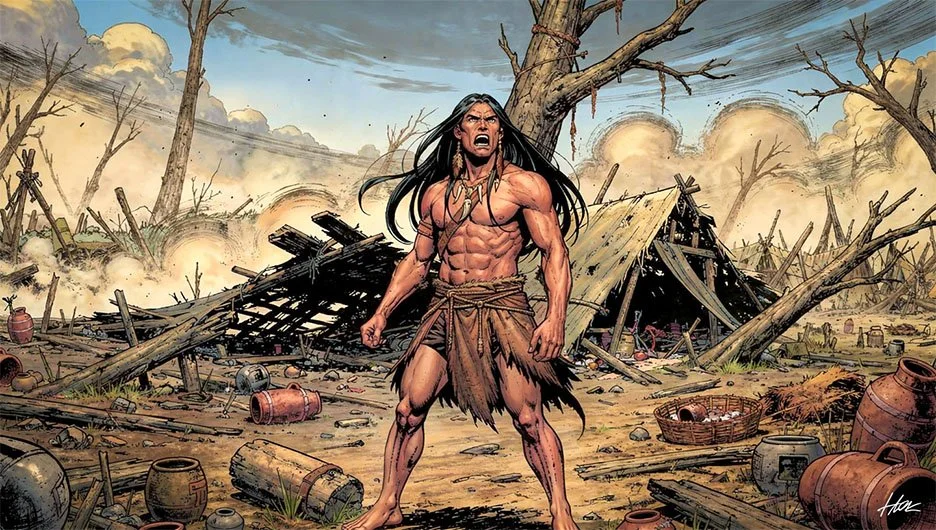
Cuetlachtli village destroyed by a tornado - © 2026 Headless Horseman Productions, LLC
He struggled to survive on his own, having never learned self-sufficiency. Isolation clashed with his belief that he was a divine being meant to be served. In search of new worshippers, he wandered south, but where reverence was denied, he turned to fear. Violence became his language. Terror his currency. Cuetlachtli wanted to be a god again. His arrogance would prove to be his greatest weakness.
In 1009, Cuetlachtli arrived in Mesoamerica, appearing one day in the northeastern Aztec city of El Tajín. Having been raised with only knowledge of others pledging their lives to him, Cuetlachtli felt he was destined to lead. He walked into the impressive settlement and stood in the city center.
CUETLACHTLI: I declare myself, ruler of these lands and people...Any who oppose me, step forward and meet your fate, as I am the light of this world.
El Tajín’s own King Milintica, the third son of Mixcoatl and leader of the Cult of Quetzalcoatl, answered the challenge.
KING MILINTICA: I call upon the Feathered Serpent, to strike down this stranger...
Cuetlachtli transformed into a werewolf slaughtering the King for all to see. Remaining in that form, he’d claim the throne. Thus began the reign of, the Tlatoani Mocuitlachnehnequi, which was Nahuatl for "Our ruler resembles a wolf”.
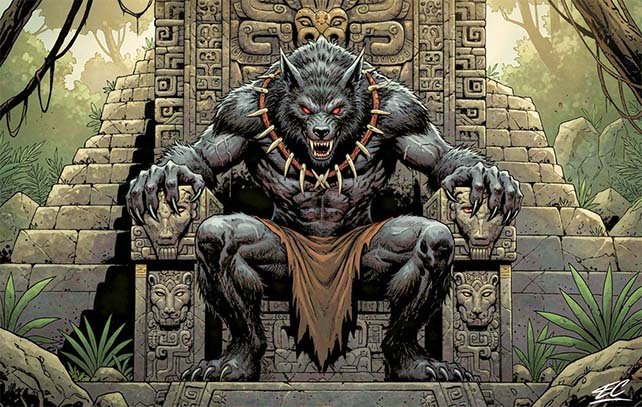
King of the Wolves - © 2026 Headless Horseman Productions, LLC
The power Cuetlachtli wielded was unmatched. No shaman equaled him. No warrior surpassed him. But his fear of isolation drove him to share his curse indiscriminately, granting it to any who pledged loyalty. It was a reckless, naïve act. Soon, a wild army of werewolves answered to him, while the human population fled in terror.
El Tajín, once a thriving city, became a brutal kingdom of the cursed. Cuetlachtli ruled blindly, sending his followers to raid neighboring villages, feeding on citizens and looting what they needed. Their hunger knew no end. Strength in numbers was the only thing holding the kingdom together. For over a century, Cuetlachtli ruled the region, convinced he was living his destiny. But his followers suffered under the curse he’d bestowed.
In 1115, a coalition formed. Neighboring villages united with defectors from Cuetlachtli’s own Otomi warrior class. Their goal was simple, end his reign of chaos. To rival his werewolves, they sought magic of their own.
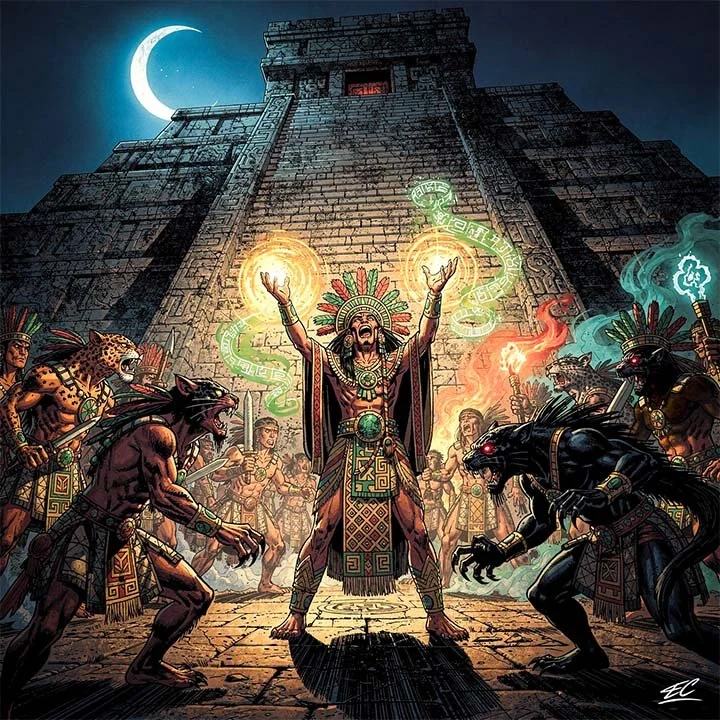
Kuzalco creating an army - © 2026 Headless Horseman Productions, LLC
A powerful shaman named Kuzalco aided them, using his magic to temporarily transform the rebels into Were-Cougars and Were-Jaguars. The resulting battle was catastrophic. Beasts clashed for days, blood soaking the land. All perished, execpt for Cuetlachtli. He cravenly fled under the cover of night, retreating north, never to be seen again.
Years following the great battle, the citizens of El Tajín and other surrounding cities fearfully awaited his return. Prophecy stated when the mountains ran red with blood, Cuetlachtli would reappear. Those in danger would hear the wolf’s cry when the brightest moon hung in the sky. But Cuetlachtli never came back. His experiment leading a strong city-state had failed miserably.
Yet the legend endured. Most famously recorded by Friar Alonso de Grijalva, who accompanied Hernán Cortés on the Spanish expedition of Mexico in 1519. The story was told to the party by Gerónimo de Aguilar, a Spanish priest held prisoner by a local Mayan tribe after surviving a shipwreck years earlier.
The powerful and descriptive tale of the King of the Wolves, was believed to have been told to inspire fear in the Conquistadors, or perhaps to justify their violence against those they deemed heathens. By 1521, Cortés had conquered the Aztecs, and the civilization was ravaged to death and disease. The Spanish account remains the only written record, often dismissed as myth.
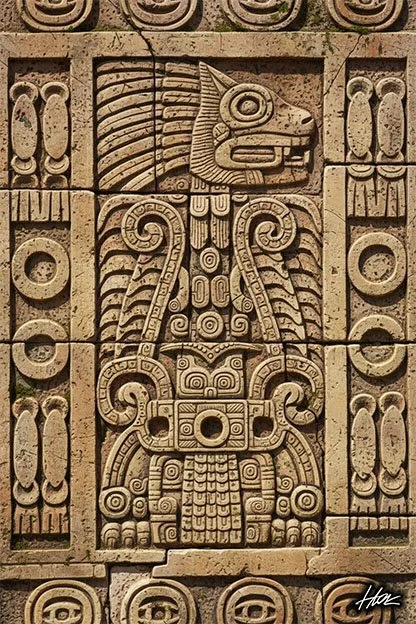
Aritst rendition of the carving of King Cuetlachtli discovered on the pyramid of Niches, El Tajin - © 2026 Headless Horseman Productions, LLC
Yet Aztec, Mayan, Tepanec, and Toltec cultures all shared legends of men becoming beasts as Cuetlachtli’s blood spread. Wolves were never central symbols in Mesoamerica, raising troubling questions. Some historians argue the story was altered to align with European folklore, rendering it implausible. And so the curse persisted, hidden in disbelief.
Though Cuetlachtli disappeared, he was still out there in the wild. A wayward king without a kingdom, wandering in search of followers. Interestingly enough Uti, while tracing werewolf bloodlines, would continue to encounter his name, again and again. Most unsettling was a correspondence dated 1879, from Colonel Robert Quick of the 13th Cavalry, ordered to capture or kill a Navajo renegade known as...Cuetlachtli. Proving the name was not merely a legend, but a figure moving through history, leaving scars wherever belief, fear, and blood converged.
TO BE CONTINUED…