
Episode 62: Nature vs. Nurture
Written By Karl White
Sharing a bloodline doesn’t mean sharing a fate. Blood carries memory, not destiny. Two souls can rise from the same source and walk in opposite directions, shaped less by what flows through their veins than by the choices they make beneath the same sky...or in this case, the same moon. Nature plants the seed. Nurture determines whether it’s tended or left to wither. And sometimes the world does neither, allowing something to grow crooked and unchecked. By the time a life takes its final form, it is impossible to say where predisposition ends and influence begins.
While Cuetlachtli’s story unfolded, defined by emotional isolation, and a hunger for power, another path had taken shape, far from his own. Forged not by absence but by presence. Their desires, needs, and destinies could not have diverged more completely, yet the same blood bound them across distance and time. What separated them was not what they were, but how they endured solitude...and how they treated what they were given.
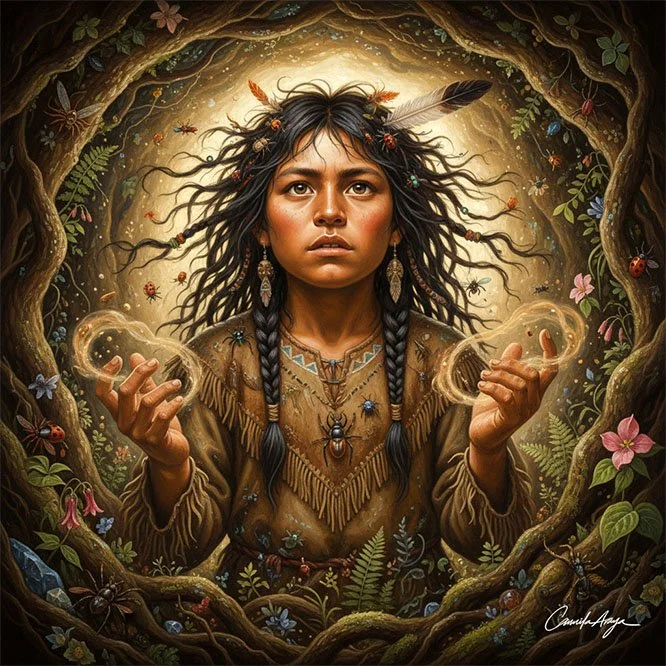
Honiahaka, boy-wolf and mage of nature - © 2026 Headless Horseman Productions, LLC
Long before there was the would-be king, there was Honiahaka. The boy who would become a werewolf as a result of the battle on the plains between Sem and the mysterious black wolf with the white eye. Honiahaka had lost his tribe and set out alone, refusing to surrender to despair. He quickly learned the acceptance he knew from his own people did not exist beyond the boundaries of home. The world was weary, fearful. But that truth didn’t extinguish his need for connection. It only made him more deliberate in seeking it out.
He moved from tribe to tribe, attempting to settle wherever he was permitted. He was honest about his affliction, and though many respected his candor, none were willing to risk an unstable force in their midst. So Honiahaka learned to live lightly among others, staying only as long as he was allowed, never forcing himself where he was not wanted.
In 298, in what is now Southern Indiana, Honiahaka encountered a small band of Shawnee women hiding in the woods. Their village had been ambushed by Iroquois warriors, their men and boys slaughtered, the women driven into flight. When the attackers came to finish what they had begun, Honiahaka revealed himself. The women watched as the boy transformed, tearing through the warriors with brutal efficiency. When the violence ended, the women did not flee. They followed him.
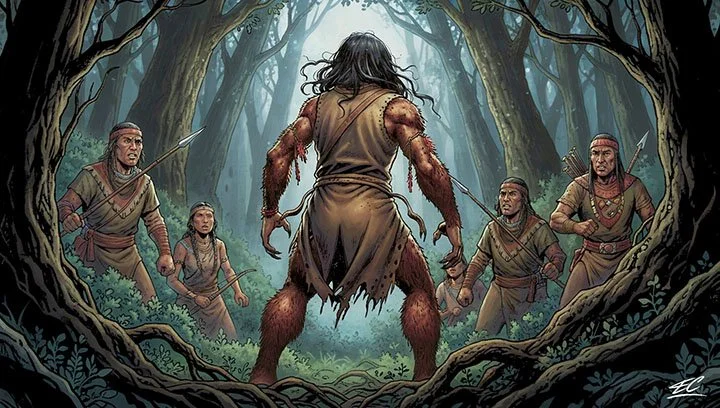
Honiahaka facing Iroquois Warriors - © 2026 Headless Horseman Productions, LLC
Together they became an unnamed tribe, led by an unlikely guardian. They wandered across what would become the American Midwest, settling and uprooting as needed. They took in the lost, those cast-aside, the unwanted. Over time, Honiahaka would make others, welcoming anyone with his curse that might treat it with the same restraint and reverence as he. Together, they’d use their combined elemental powers to forge lives, depending on the earth more deeply for their survival.
Decades became centuries. Honiahaka and his people honored the land through balance, refusing to harm other humans. They believed the curse was not a weapon, but a responsibility. In this, Honiahaka stood as the inverse of everything Cuetlachtli would later become...an irony made all the sharper by the fact that from Honiahaka’s bloodline, the egotistical Wolf King would one day be born.
The tribe became a family in the truest sense. They lived together, raised children together, even among the cursed. Werewolves and humans shared life communally, bound by trust rather than fear.
Seneca was a young woman, born to human parents within Honiahaka’s tribe. Ohiyesa was a longtime member, found by Honiahaka, wandering alone on the brink of death. Ohiyesa pledged his life to Honiahaka and later accepted the curse of the werewolf. He was a trusted member of the clan but held a secret that he and Seneca kept from the rest of their brethren. Love had formed quietly between them. Against doctrine, Ohiyesa passed the curse to Seneca in secret. Their union resulted in a pregnancy neither knew how to reveal.
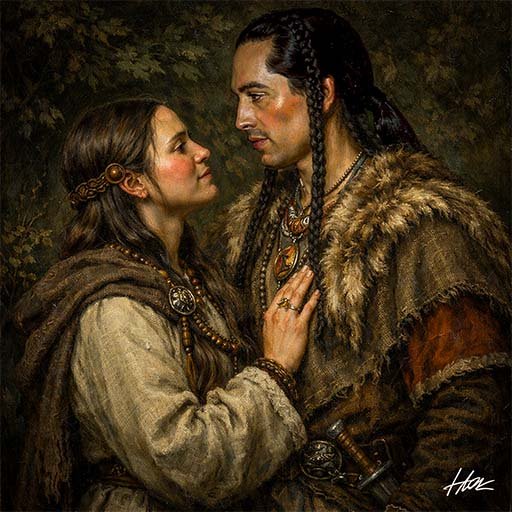
Seneca and Ohiyesa - © 2026 Headless Horseman Productions, LLC
Breaking tribal law carried severe consequence, exile, even death. So Seneca fought her first change, suppressing it. The lovers delayed confession, hoping to find a path that would spare them all.
In the winter of 610, a brutal northern cold forced the tribe to seek shelter. They were welcomed into the Cahokia settlement near the Mississippi River. But as the storm raged, the secrets being kept could no longer be contained…Seneca went into premature labor, and during the birth of her child, the trauma triggered her first transformation.
Uncontrollable in her werewolf form, Seneca tore through the village, leaving blood and carnage in the freshly fallen snow. The sudden, violent outburst forced Honiahaka and his tribe to flee, for fear of being exposed.
In the aftermath, Seneca and Ohiyesa were put to death for their deception. But neither Honiahaka nor the others knew that a child with werewolf blood had been left behind. Cuetlachtli never knew his parents, and the cruel irony of it was, had he been raised under Honiahaka’s guidance, his life might have unfolded very differently.
Following the incident with the Cahokia, Honiahaka and his tribe, journeyed as far away from danger as they could, migrating all the way to the east coast. They’d settle along the marshlands of what would later become Massachusetts. For the first time in centuries, they intended to stay. No longer would they run from who they were.
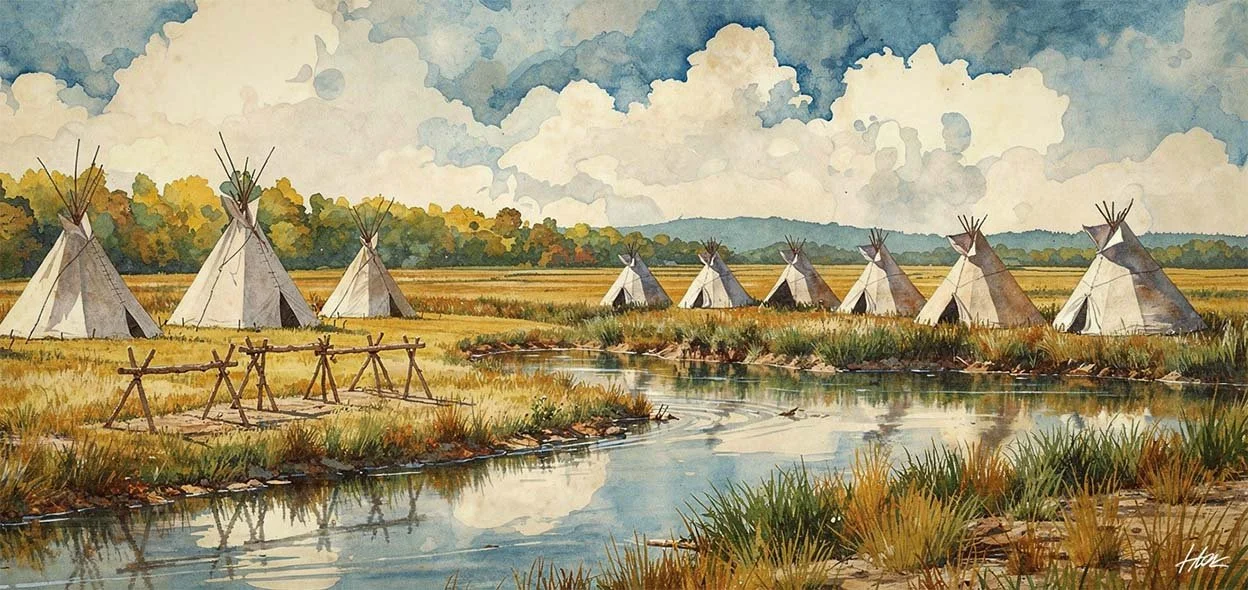
A permanent settlement - © 2026 Headless Horseman Productions, LLC
Honiahaka sought peace for his tribe and as the centuries passed, roots of the settlement grew deeper. The tribe mostly kept to themselves, living in harmony with the neighboring Wampanoag, Narragansett, Nipmuc, and Pocomtuc tribes -- all of which knew they were shapeshifters.
For as much good as Honiahaka and his people did for the natives in the area, history would ultimately paint the tribe in a negative light. By 1674, as settlers from England arrived in the “New World”, indigenous populations began to be forced from their lands by the ever-growing delegation of Puritans.
Desperate, Honiahaka approached the English peacefully wanting to establish a compromise. But witnessing the aggressive nature of the Europeans, he and his clan made a grave miscalculation. Refusing direct violence, they would turn to nature instead, to reclaim what was rightfully theirs. Befriending a naive young Puritan girl named Mary Hope, they secretly inflicted her with the curse while she played in the nearby forest.
Returning to her village, Mary soon began showing signs of illness, a crippling fever, and night terrors, as the curse began taking hold. Her parents praying at her bedside learned what happened.
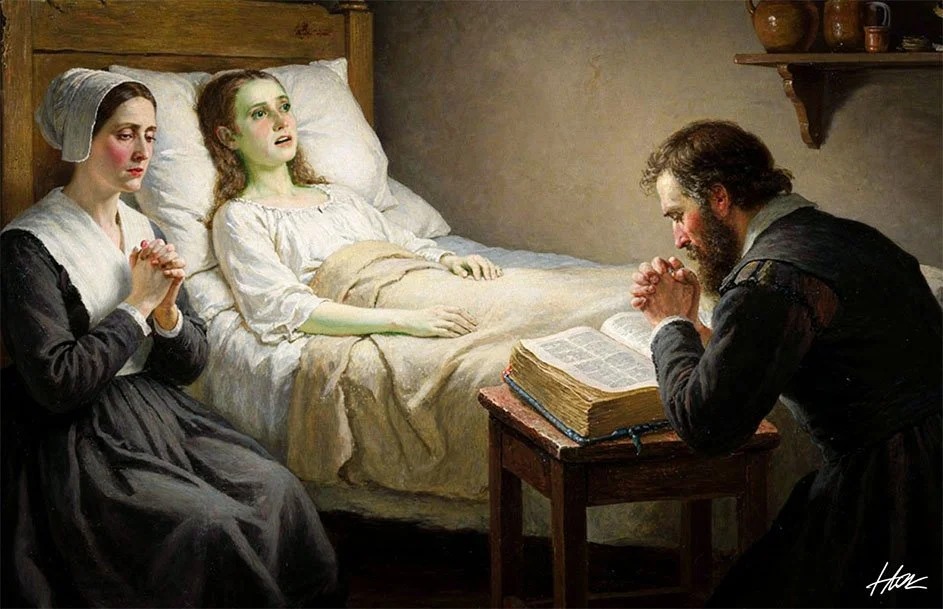
Mary Hope takes ill - © 2026 Headless Horseman Productions, LLC
MARY: The natives made me drink something, saying it would draw me nearer to the spirits of the earth. That we were never meant to claim such power as our own. (groans) Mother...father...I feel it moving within me now. The spirit...it burns.
Soon after she shifted, Mary, in her werewolf form, went on a violent killing spree, destroying several Puritan towns. But it did not have the desired effect, as the English retaliated against Honiahaka, and other nearby tribes. Setting off a series of battles that would be the inciting factors of King Philip’s War.
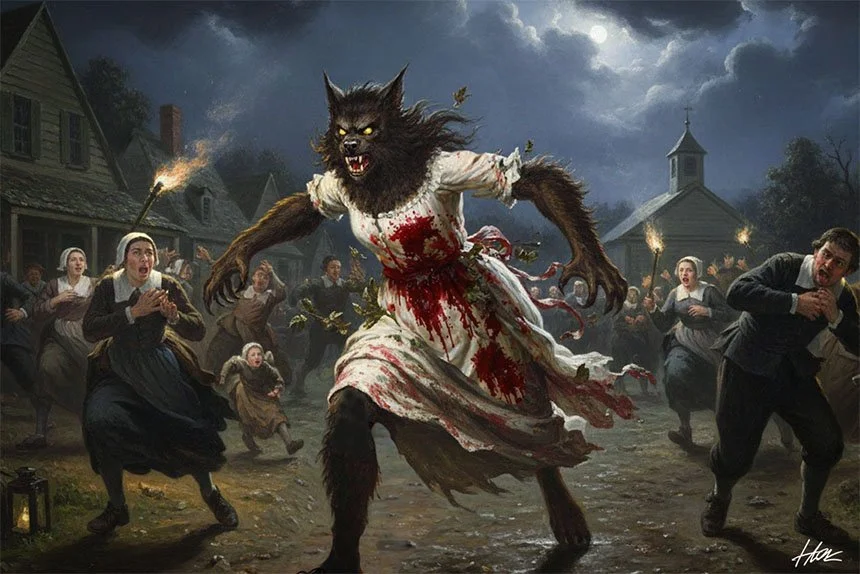
Werewolf Mary runs amok - © 2026 Headless Horseman Productions, LLC
Of course, Honiahaka and the werewolf members of his tribe, could have easily ended the Puritans once and for all, using the power of their affliction to put an end to the conflict...but they decided the war over land was between men, refusing to use their might as weapons.
The decision would regretfully be the end of Honiahaka and his followers, as they perished in 1678 in a firefight with the settlers...A tragic end, for one who believed the curse was meant to protect life, not dominate it.
TO BE CONTINUED…