
Written By Karl White
As with the nature of any disease, what begins in one body does not always end there…it moves, from one host to the next, taking what it can, ensuring it's survival.
The spread of the Black Wind of Death, radiated outward as mankind flourished. In those early ages, there was no understanding of disease or contagion. No one knew how it traveled, or what unseen forces carried it from one settlement to the next. When the sickness appeared, it came like a judgment borne on the air. Villages that stood for generations could fall silent in a matter of days, their people rising again in a grotesque imitation of life. Survivors fortunate enough to escape could only guess at what occurred, and their warnings moved slowly, carried by rumor and fear.
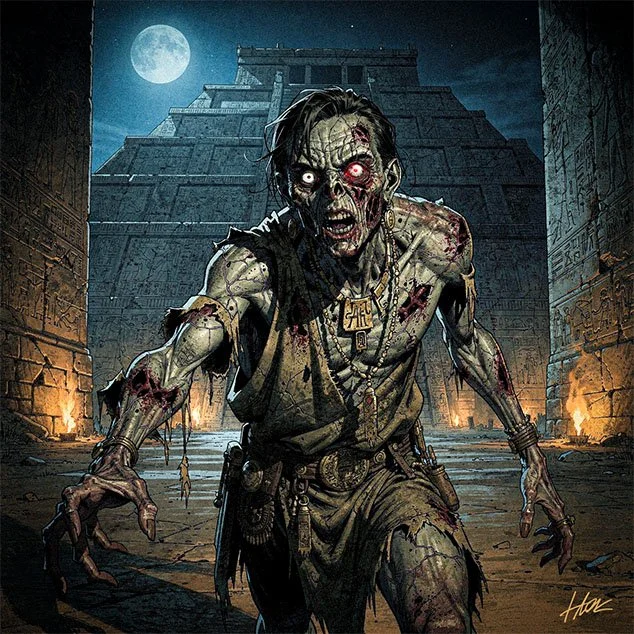
The Black Wind spreads through the ancient world - © 2026 Headless Horseman Productions, LLC
In time, scattered records of outbreaks surfaced across the early civilizations of the Eastern Hemisphere, whispered accounts etched into clay tablets, scratched onto temple walls. Nearly all shared a common thread -- the sickness followed the roads of mankind. These were the places where the Black Wind moved most easily. As trade expanded and populations grew, so too did the reach of the plague, creeping through the arteries of society.
The spread of the sickness was not always an accident of travel. In the shadows of early cultures, darker hands steered humans to recognize the power hidden within the virus. Demons whispered in receptive ears, guiding hands towards it. Intended for those who sought a different kind of power.
Kings, conquerors, and tyrants would come to unleashed the sickness of control. It was used to silence dissent, to erase rebellion, and to instill fear so absolute that resistance would collapse before taking form. The infected became instruments of terror, their suffering repurposed as a warning to the living.
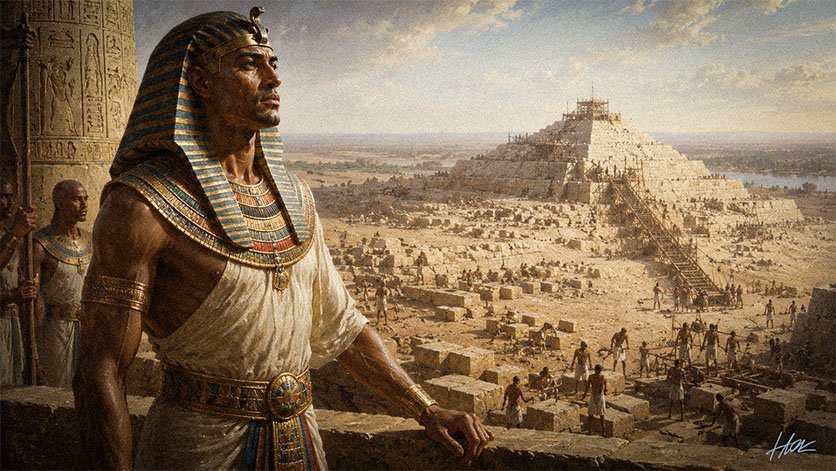
King Khufu - © 2026 Headless Horseman Productions, LLC
In Egypt, around the year 2566 BCE, the reign of King Khufu had begun to fracture. The great monuments of his kingdom demanded endless labor, and quiet rumors of revolt spread along the Nile. Workers vanished into the desert quarries and did not return. Grain taxes grew heavier. And across the floodplains, resentment simmered among a population pushed to the edge of insurgence. Fearful the kingdom he built might collapse beneath him, Khufu turned not to diplomacy but to a darker counsel.
The Pharaoh’s spiritual advisor, a wandering mystic named Ba’el, spoke of a force capable of breaking the will of the king’s enemies and restoring order. What Khufu didn’t know was his advisor was a demon wearing the skin of a man...pushing him to release the Black Wind of Death
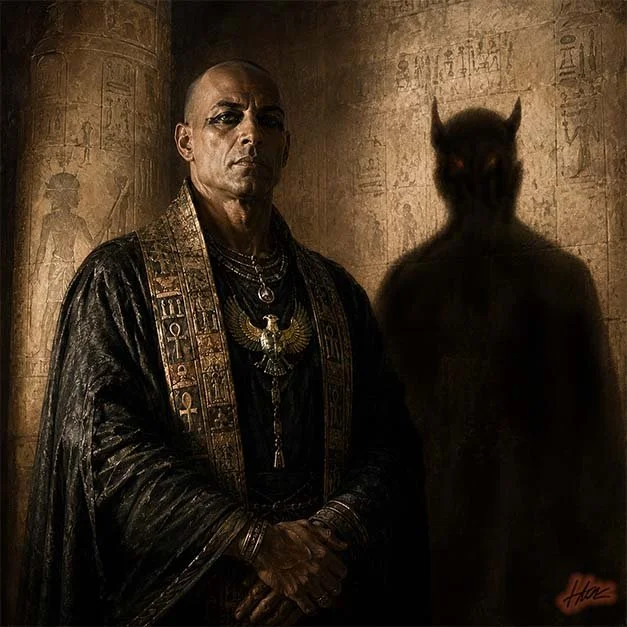
Ba’el, the Pharaoh’s advisor - © 2026 Headless Horseman Productions, LLC
Khufu ordered the plague to be unleashed. But it spread with a speed and reach far beyond anything he anticipated. Entire work camps fell silent as the infected rose again in violent hunger. Panic rippled through the cities of the Nile as the sickness moved from village to village, carried by fleeing survivors and the relentless advance of the dead.
For a brief and horrifying moment, the Pharaoh believed the curse worked, that fear would crush the rebellion before it began. Instead, his kingdom teetered on the edge of ruin. What was intended as a weapon to preserve order nearly became the end of Egypt itself...and the demon, Ba’el vanished long before the consequences of his deception could be understood.
In desperation, Khufu’s guards imposed ruthless measures to halt the contagion. Infected villages were sealed or burned. Their inhabitants entombed behind walls of mud brick or consumed in great funeral pyres along the riverbanks. Armed patrols hunted the wandering dead into the far reaches the of desert, while priests declared the afflicted to be cursed by the gods, forbidding anyone from approaching them.
Slowly, the outbreak was brought under control. But the victory came at a cost. Entire communities vanished, and for generations afterward whispers lingered of the year when death walked the floodplain. The Pharaoh claimed the gods had purged Egypt of a great evil, but in truth the kingdom barely survived a catastrophe of its own making.
In the end, the Pharaoh’s greatest fear came to pass. As the plague receded and the full scale of the devastation became clear, anger spread among the very men sworn to protect him. Guards who carried out the king’s merciless order, but who also watched family members perish in the outbreak, knew the crisis began from Khufu’s own hand. The revolt he feared didn’t rise from the peasants, but much closer. The men who stood as the shield of his rule became his executioners.
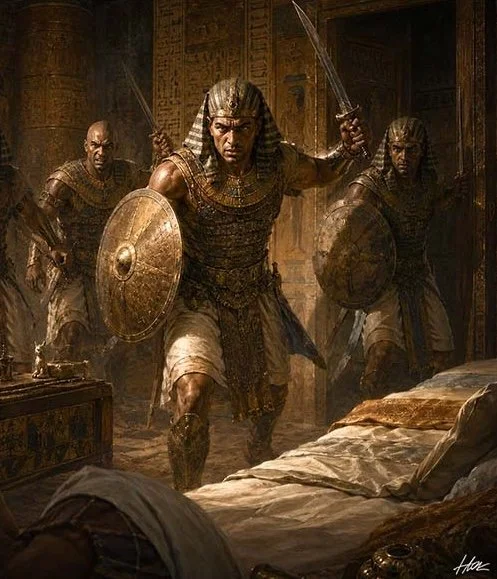
The King’s guards come for him - © 2026 Headless Horseman Productions, LLC
But using the plague for control came in other forms. The dark and brutal history of the trade of human beings for forced labor remains one of the deepest scars in our shared history. The buying and selling of people rarely operated within the bounds of law or morality. And thrived in shadows, where greed, fear, and power outweighed any sense of equality. In those places, cruelty was not an exception but a constant.
Across centuries, rumors spread among slave traders and landowners of a more obedient kind of laborer, one incapable of rebellion, escape, or thought. In parts of West Africa, stories of the Zombi existed long before these rumors traveled beyond their origins. In Vodun beliefs, a Zombi was a dead person raised and bound to the will of a master, existing in a state between life and death, stripped of spirit and identity. Within those cultures, the fear of such a fate was profound, as the loss of one’s freedom was considered worse than death itself.
Among traders it was believed the walking dead could be created and trained for work. For those who controlled vast lands or required enormous workforces, the idea carried a dangerous appeal. Feeding, housing, and controlling unwilling laborers was expensive and risky. Rebellions were always possible. But the promise of mindless workers, who required no care, felt no pain, seemed like the perfect solution. But those foolish enough to pursue such power rarely understood the danger they were inviting.

Infected gorilla attack - © 2026 Headless Horseman Productions, LLC
In 1760 BCE, during the construction of a pyramid commissioned by the Pharaoh Imyremeshaw, a coffle of slaves was brought north to Egypt from distant African villages. During the long march toward Cairo, the caravan was attacked in the wilderness by a rabid gorilla carrying the zombie plague. Several thralls were killed in the chaos, and though the beast was eventually slain, the survivors were forced to continue their journey.
One man, who had been badly mauled by the primate, began to show signs of a strange illness. Weak, feverish, and barely able to stand, he pleaded for relief, but the overseer, known among the workers as the lash man, refused to halt the march. When the caravan finally arrived at the construction site, the man collapsed among the laborers -- and then rose again.
The transformation was swift and violent. In the center of the camp, before hundreds of terrified slaves, the man turned into one of the walking dead, attacking anyone within reach. Panic ensued as the infection spread. Within minutes, the site descended into bedlam. Some fought for their lives, able to escape, but most fell victim to either brutality or reanimation.
At the epicenter of the slave camp, it took several days of fighting, burning, and containment before the outbreak was finally subdued. By then, the damage was beyond repair. The construction site was declared cursed.
The unfinished structure and surrounding camps were burned to the ground in an attempt to cleanse the land. Yet even this desperate measure came too late. Several infected had already escaped into the wilderness, some bitten, others exposed through contact. Fleeing without understanding what they carried, they spread the plague southward through the Nile corridor and along the northeastern coast of Africa, ensuring the proliferation of death.
Over the next five centuries, scattered accounts of the walking dead would surface across the region, small outbreaks, isolated villages lost, caravans vanishing along trade routes. Each incident was blamed on angry spirits, or the wrath of forgotten gods. But in truth, the plague was just starting its forward march through history.
TO BE CONTINUED…