
Written By Karl White
For generations, the Black Wind lingered like a shadow over Northeast Africa. The walking dead weren’t spoken of as legends or superstitions there, but endured as a grim and familiar reality. The sickness rose in cycles, emerging from the wilderness or along forgotten trade roads, spreading through villages before erupting into violence and fear.
Nowhere was this tension felt more than the Ethiopian Highlands. Unlike the vast deserts of Egypt and the Sudan, the highlands offered rivers, forests, and fertile valleys, places where refugees, wanderers, and escaped slaves could disappear and begin again. Over centuries these mountains became a crossroads of those fleeing hardship and tyranny. But wherever people gathered, so too did danger. When the plague surfaced in these settlements, it could spread quickly through the narrow valleys that stitched the region together.
Local tribes did what they could to confront outbreaks, though few were prepared for the horror of facing the dead. In response, hunting bands formed, small, disciplined groups tasked with tracking and destroying the infected before the sickness could spread.
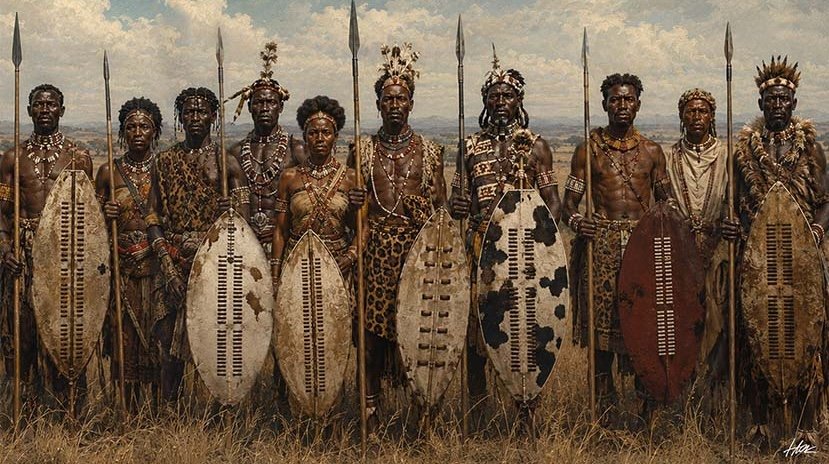
The Ababulali Bokufa - © 2026 Headless Horseman Productions, LLC
Among the most respected of these warriors were those drawn from two powerful tribes the Zande and the Zulu, renowned for their mastery of the hunt, their skill in war, and their endurance in the wild lands between kingdoms. Emissaries from these tribes traveled the trade routes, hired to watch over villages and caravans, their services paid for in cattle, ivory, or gold dust.
Over time, these efforts proved so effective that a select few chose to devote themselves entirely to the task. They hunted the walking dead wherever the Black Wind appeared, pursuing the plague across fertile lands. This brotherhood came to be known as the Ababulali Bokufa, a name that translated to “Those Who Slay Death”.
The Slayers became a disciplined and formidable force. They learned to recognize the earliest signs of an outbreak, to quarantine the afflicted, to destroy the reanimated before they could spread the sickness, and to guard themselves against the contagion. Their mastery became known far and wide. Wherever the reanimated rose, the call went out for the Slayers, warriors who stood between the living and the dead. And among their ranks, one man would eventually rise above the rest. His name becoming inseparable from the history of the Black Wind of Death.
Bhekizizwe was born into the legacy. His mother survived a zombie attack as a young girl and later joined the Ababulali Bokufa, dedicating her life to the order. She was a fierce and relentless fighter, respected by her peers. In time, she found a life within the brotherhood, falling in love with another Slayer, together they raised a son among warriors.
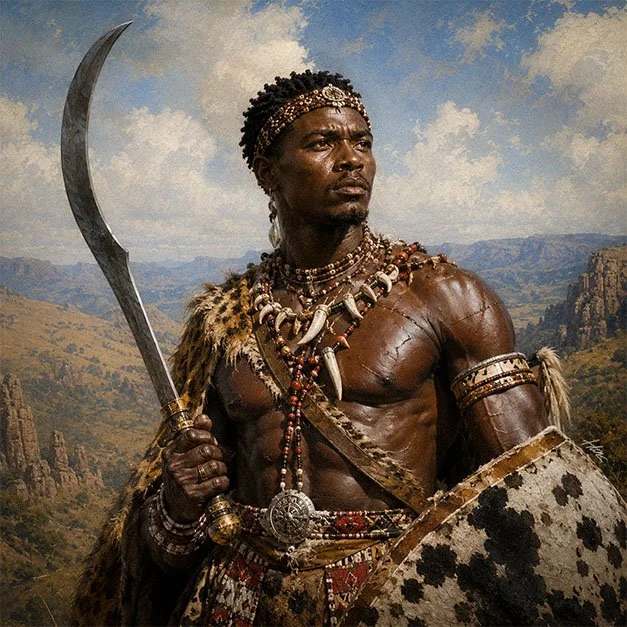
Bhekizizwe - © 2026 Headless Horseman Productions, LLC
From an early age, Bhekizizwe hunted alongside his parents, learning the discipline and precision required to face the dead. He was known for his patience in battle, a calculating fighter who favored measured strikes over reckless aggression. He carried a large khopesh, a curved blade uncommon in the region, and wielded it with devastating effectiveness. Through his cunning, and command, Bhekizizwe rose through the ranks, eventually earning the supreme rank of Inkosi.
But the Slayer’s fortunes would change in 1290 BCE. While tracking an outbreak along the Omo Valley, the band found themselves standing between a village and a massive roving zombie horde. But these creatures were unlike any they’d faced. Prior outbreaks had been terrifying, but predictable. The infected were slow, shuffling corpses, dangerous in numbers but lacking coordination or speed. These zombies were different. Faster, more violent. Their movements sharp, almost predatory, rather than mindless dead.
The Slayers were caught off guard. Though Bhekizizwe fought with relentless ferocity, cutting down dozens of the reanimated with his curved blade, the band suffered devastating losses. His father was killed in the chaos. And among the wounded, his mother was bitten. Before the sickness could claim her, Bhekizizwe, with great sorrow, was forced to end her life.
Something within the plague had changed. It was evolving, adapting, becoming something far more dangerous, as pathogens do. Bhekizizwe understood the trail would not hold for long, and if it slipped away, the truth behind the plague would be lost with it. Though the Slayers had been devastated, he refused to withdraw. With a smaller, battered force, he pushed forward into the hunt, choosing pursuit over safety, determined to track the new affliction to its source while it could still be followed.
They’d journey north along the Red Sea coast, following scattered reports of the rabid dead and the destruction left in their wake. The path eventually led them into Egypt.
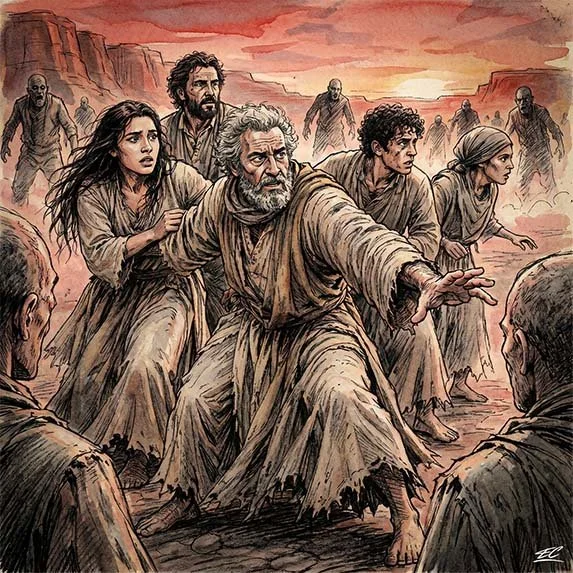
Travelers in the desert, surrounded - © 2026 Headless Horseman Productions, LLC
Deep in the desert, Bhekizizwe and his warriors encountered a small band of wanderers under attack by a pack of the savage infected. The Slayers rushed to their aid, fighting with desperate courage beneath the setting desert sun. But the creatures were relentless. One by one the remaining Slayers fell. When the battle was over...only Bhekizizwe remained, having given everything to save the strangers.
The leader of the group, a man known as Moses, had traveled widely through the lands of Kemet, and had seen the plague before. To him, it felt like judgment, or perhaps something darker still. Witnessing Bhekizizwe’s courage and learning of the Slayers’ purpose, Moses sought to offer him something in return.
MOSES: You’ve given much, warrior. Your companions lie fallen, yet you stood until the end. Tell me, what would aid you in the path you now walk?
BHEKIZIZWE: Every battle is its own war. Each time I’ve faced this plague I’ve stood at a disadvantage...I’m but a man, and the fear of death, of the sickness, shadows me.
MOSES: In the long years of my wandering, I’ve seen many signs from the Almighty. You’re one of them. Heaven brought you to this place...and to me.
BHEKIZIZWE: I am but a humble warrior who hunts the dead, not someone chosen.
MOSES: But can’t you see, that’s why you are chosen.
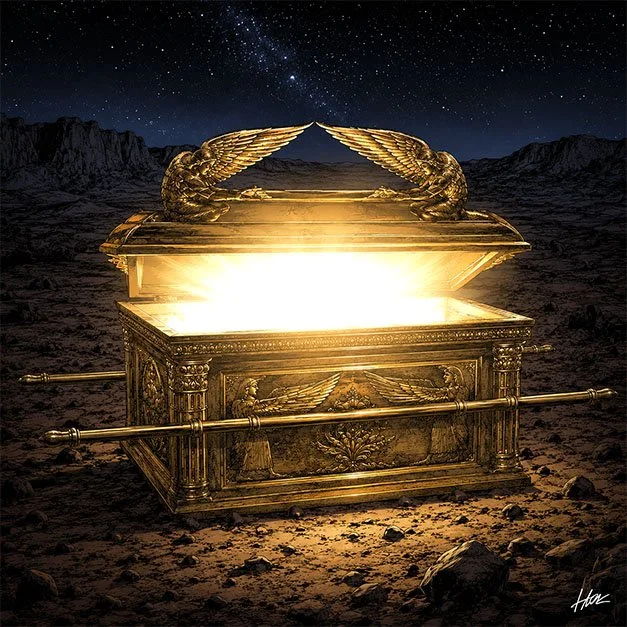
Bhekizizwe’s fate - © 2026 Headless Horseman Productions, LLC
Beneath a bright moon, in the cooling desert air, Moses revealed a sacred relic -- the Ark of the Covenant. Bhekizizwe didn’t understand what was about to unfold, but as his eyes fell upon the relic and the power it carried, something within him changed. The warrior was touched by a divine force, and in that moment, he was granted the gift of the Eternal.
As we learned back in Season One, Eternals are humans gifted with everlasting life. They cannot die by natural means, though they may still be wounded or destroyed. Some are transformed through passage between planes of existence, others through the will of powerful entities, beings such as Death, or the Seraphblade, Kharos. And in rare cases, the gift is bestowed through relics of immense and sacred power.
Moses believed this transformation was mankind’s best chance against the spreading scourge. If Bhekizizwe couldn’t die, he could not fall to the plague...even if bitten. That was a hell of a weapon to wield in the fight against an enemy that spread through such means.
And so Bhekizizwe continued his hunt. He pursued the source of the rising hordes, saving countless lives along the way. In time, he gathered a small but loyal following, warriors drawn from many tribes and lands, rebuilding the Slayers and giving mankind something it had not yet possessed in this war -- a fighting chance against the Black Wind of Death.
TO BE CONTINUED…