
Written By Karl White
The plague was a masterstroke by the Dark. The virus was highly contagious, easily transmittable, designed to spread itself, proliferate, and endure. Wreaking havoc from victim to victim with ruthless efficiency. And like all the most devastating weapons ever conceived, its true power wasn’t in its design alone, but in how willingly mankind would come to wield it.
Throughout history, humanity’s capacity to destroy itself through conflict and war has evolved with remarkable ingenuity. Chariots, armor, longbows, gunpowder, and steel chart the progression of violence. Yet weapons carried in hand or mounted on horseback were never the only path to victory. More insidious than any blade, more devastating than any artillery, the plague became a weapon of a different kind.
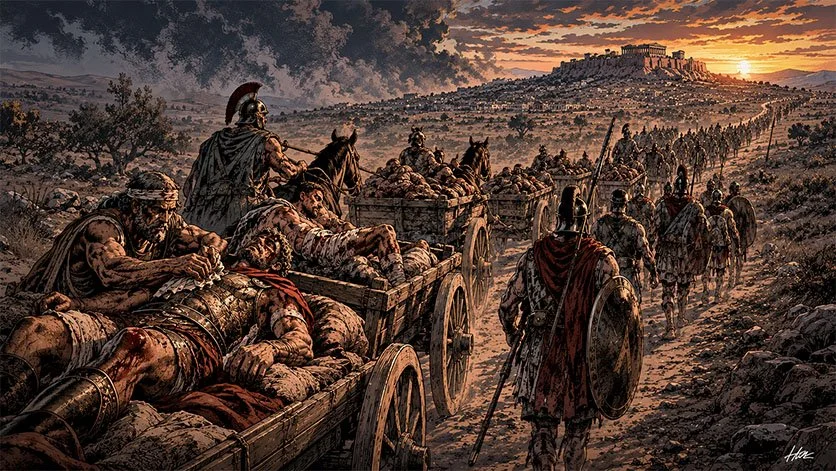
After the Battle of Marathon - © 2026 Headless Horseman Productions, LLC
In 490 BCE, following the brutal clash between Greek and Persian forces at the Battle of Marathon, the road back to Athens was choked with the wounded. Carts groaned under the weight of injured hoplites, their bodies broken from the day’s fighting. Among the men guiding those wagons was Theron of Acharnae, a quiet soldier who’d spent most of the battle hauling the injured away from the fighting rather than wielding a weapon. The work was grim, but necessary. But not all of the wounded along that road were what they seemed.
In the confusion following the Persian defeat, a small detachment of enemy soldiers carried out a desperate plan. Unable to overcome the Greeks in open battle, they sought instead to turn the Black Wind into a weapon. A handful of infected, victims of the zombie plague, were dressed in the armor of fallen Greeks and left among the wounded waiting for transport. Their intent was simple, once inside the walls of Athens, the sickness would spread through the heart of the city.
The deception came close to success, but Theron noticed something amiss among the silent figures waiting by the roadside. Their skin bore the gray, waxen pallor of decay, and their movements were stiff, unnatural. He had heard the stories, whispers from traveling merchants of a sickness that caused the dead to rise.
Theron raised the alarm. Nearby soldiers drew their blades and leveled their spears just as the first of the disguised corpses lunged. The violence that followed was swift and brutal. When it ended, the infected were dragged into a ditch. Theron himself gathered brush and shattered wagon boards, setting the bodies alight to ensure the sickness would go no further. Athens never knew how close the plague had come to crossing its gates, and altering the course of its history.

Deception on the road to Athens - © 2026 Headless Horseman Productions, LLC
In 331 BCE, during the campaigns of Alexander the Great, rumors spread of a Persian satrap attempting to poison Macedonian supply lines with infected corpses...the plot was discovered before it could take hold.
In 214 BCE, amid the chaos of the Second Punic War, a Carthaginian commander was said to have released plague-ridden captives toward a Roman encampment under the cover of night.
In 70 CE, as Titus laid siege to Jerusalem, accounts claimed that diseased bodies were hurled over the city walls using catapults. Some corpses didn’t remain still once they landed.
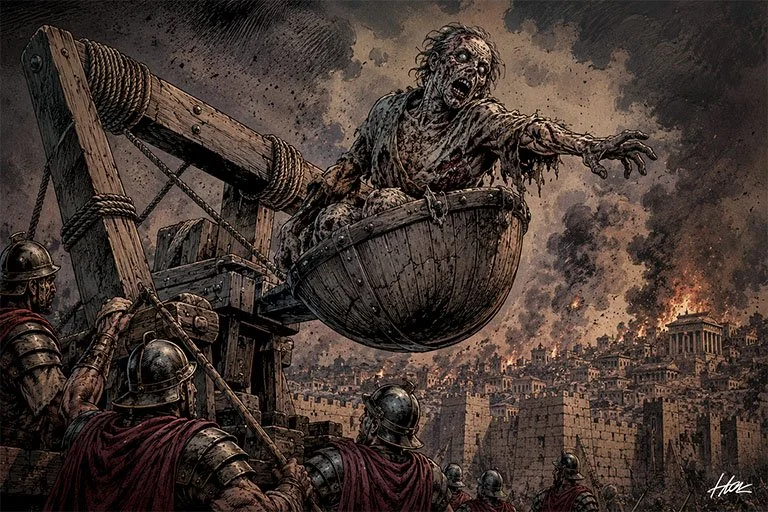
Titus’ men using catapults - © 2026 Headless Horseman Productions, LLC
In 1066, on the blood-soaked fields of Hastings, the fate of England hung in the balance. King Harold II held the Norman advance for most of the day, his shield wall stubbornly resisting waves of attacks from Normandy’s forces. But as evening drew, the tide began to turn. Amid an attack of arrows, the English king was gravely wounded and carried from the fight by his loyal housecarls.
The moment was critical. If the king died, the fragile defense would collapse. Among those tending to him was Edric of Winchester, a physician who, in desperation, chose a path no healer should ever take. As Harold drifted toward death, Edric administered a vial of the Black Wind.
For a fleeting moment, it seemed to succeed, as soon the fallen king rose, defying his mortal wounds. But the victory was hollow. The reanimated monarch turned on his own men, forcing the soldiers to act without hesitation. Harold was struck down and decapitated before the sickness could spread among the wounded. His body was burned, and the truth of what occurred was buried beneath the legend of the battle.
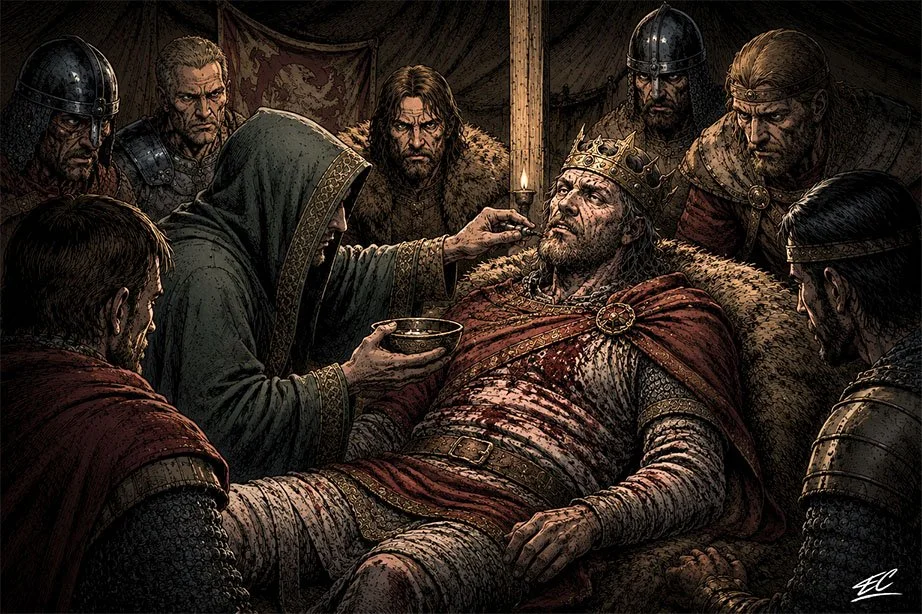
King Harold II given the Black Wind of Death - © 2026 Headless Horseman Productions, LLC
In 1493, the lands surrounding Constantinople, then the capital of the growing Ottoman Empire, remained a contested frontier between east and west. Though the Byzantine Empire had fallen decades earlier, Venetian and Aegean forces continued to challenge Ottoman control along the coasts and plains. One such conflict unfolded along the shores of the Sea of Marmara, where a Venetian-led force sought to disrupt the trade routes feeding the imperial capital.
Among the Ottoman commanders was a provincial officer, Kemal Bey, a ruthless tactician who’d heard unsettling stories of a sickness capable of turning the dead into weapons. Believing fear could shatter the enemy’s resolve, he ordered several infected slaves to be driven forward under the fog of battle. The men staggered into the fray, cut down as the fighting raged.
Moments later, the bodies rose again. The infected surged to their feet in a frenzy, attacking Ottoman and Venetian soldiers alike. Panic spread as bitten men fell, only to rise again among the living. Order collapsed into confusion as commanders on both sides realized the outbreak threatened to destroy them all.
In a desperate truce, Ottoman janissaries and Venetian infantry turned their blades against the walking dead, cutting down the infected where they stood, before the plague could spread further. By nightfall, the battlefield had been transformed into a landscape of fire, as survivors from both armies burned the dead in great pyres that lit the darkness. No victory was claimed that day. But among the soldiers who lived through the horror, stories would circulate for years afterwards of the strange battle.
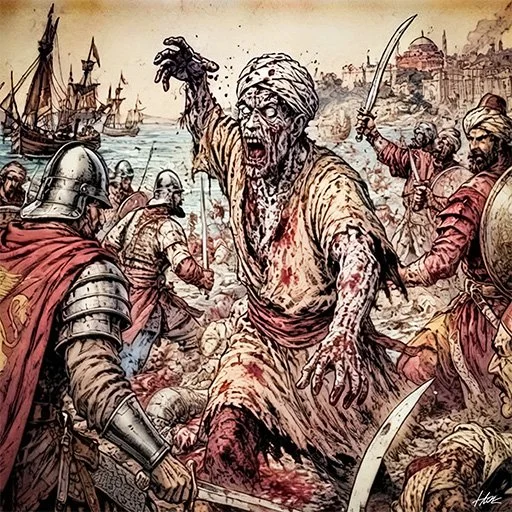
Zombies on the battlefield - © 2026 Headless Horseman Productions, LLC
In 1704, during the Battle of Blenheim, French and Bavarian forces prepared to launch a surprise assault against the advancing armies of the Grand Alliance. A thick morning fog clung to the Danube valley, delaying the French attack as commanders waited for visibility to improve. Soldiers on both sides stood in uneasy silence, muskets primed, waiting for the battle to begin.
But mayhem suddenly erupted among the French ranks...Several soldiers stationed along the forward pickets collapsed, writhing with strange convulsions. Moments later, they rose again, attacking the men beside them with savage ferocity. Panic spread through the fog-shrouded ranks as the infection took hold among the tightly packed formations. In the thick mist, it became impossible to distinguish the wounded from the walking dead. Officers shouted conflicting orders while terrified infantry fired blindly into the haze. By the time the outbreak was contained, dozens had fallen, not to the enemy, but to one another.
The origin of the sickness that morning was never confirmed. Some officers whispered of enemy agents using the Black Wind as a form of biological warfare. Others believed it had traveled unseen along Europe’s peasant roads, waiting for the right moment to emerge. Whatever the truth, the incident was quickly buried beneath the larger history of the battle.
And so the lesson never changed. Each time the plague was unleashed, it proved the same irrefutable truth, it couldn’t be controlled, and it wouldn’t faithfully serve the hand that wielded it. Yet rather than abandon its use, men concealed its failures. The aftermath silenced, the horror reframed, and the cause erased. What endured was not the truth, but the promise, the belief in a weapon still waiting to be mastered. Passed from one generation to the next by those arrogant enough to believe they could command death, never realizing it was death that commanded them.
TO BE CONTINUED…