
Written By Karl White
As travel expanded between distant civilizations, so too did the opportunity for the plague to spread. For most of human history, outbreaks of the zombie virus remained small and isolated. Traders, soldiers, and pilgrims would occasionally carry the sickness from one region to another, but in many cases the danger was recognized quickly enough to stop it.
As oceans bridged worlds apart, so too did new forms of communication, among those who traveled them. Over time, certain practices emerged to warn travelers of contaminated ground. Burial sites where the walking dead had been destroyed were often marked with a simple symbol carved into stone or wood -- an inverted “V” bisected by a single line. The mark served as a grim, silent warning to anyone who passed by, that death had walked there once before.
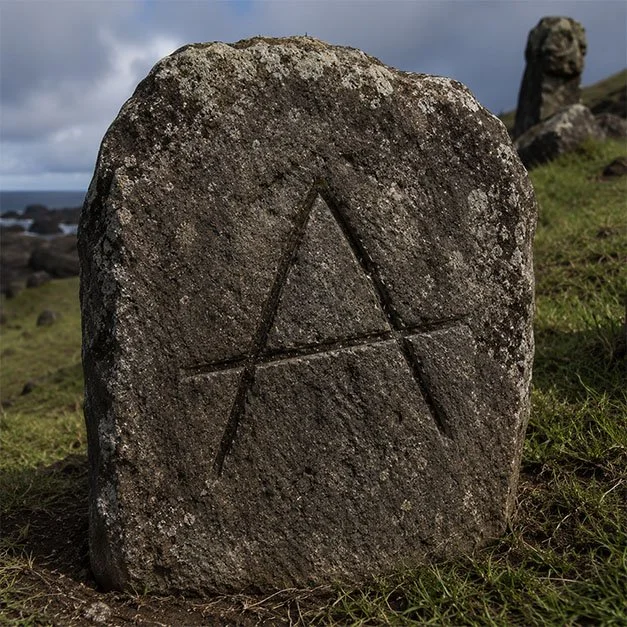
Ancient warning sign found on the coast of the Kharu Atoll - © 2026 Headless Horseman Productions, LLC
Sailors, merchants, and horse riders came to recognize the symbol across many lands. It became one of the earliest shared warnings between distant peoples, a language without words that spoke of the Black Wind and the devastation it left behind.
But as the centuries passed, one location in particular came to occupy a darker place in the minds of those who sailed the Pacific. A small uncharted island near Micronesia, was known among seafarers as -- The Island of the Dead.
According to ancient oral traditions, the island was first encountered around 168 CE by a Polynesian tribe navigating the scattered archipelagos of the western Pacific. When their canoes made landfall, they expected to find fresh water, and perhaps signs of life. Instead, they discovered something far more disturbing. The island appeared inhabited...but not with anyone living.
The jungle was filled with reanimated corpses, remnants of an unknown people, wandering aimlessly among the ruins of long-abandoned huts and overgrown paths that spoke of a life extinguished long before the voyagers arrived.
The explorers fled the island without delay, carrying word across the Pacific of a cursed land where death refused to rest. Along parts of the shoreline, sailors would later claim to find ancient stone markers carved with warnings of the plague, suggesting long before its rediscovery, someone had already tried to keep the world away.
Still, the mystery endured. How had the dead persisted there for so long? Had the warm tropical climate preserved them, or was the island itself something more...a place where the plague had taken root. A ground zero.
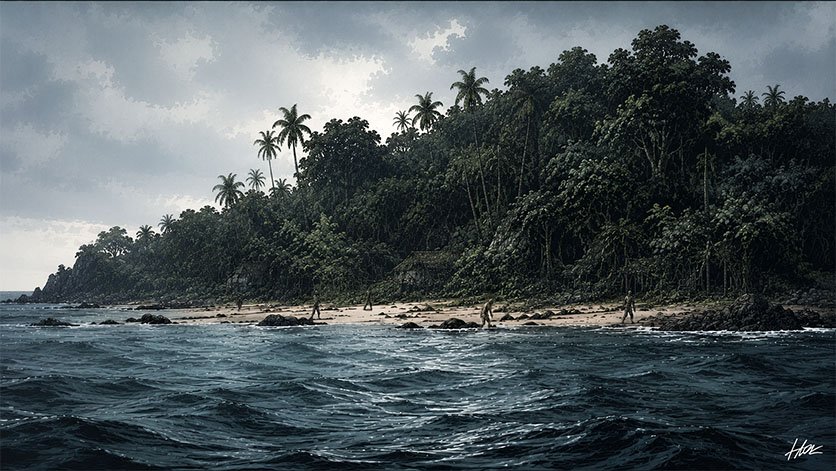
The Island of the Dead - © 2026 Headless Horseman Productions, LLC
For nearly two millennia, the island remained a dark legend among seamen. Occasionally, ships would make landfall in search of water or timber. Most crews quickly understood something was wrong and escaped with their lives. Others were not so fortunate. And with each encounter, the sickness would sometimes escape the island’s shores. Birds and other animals carried fragments of the contagion to nearby islands and scattered atolls, seeding the region with quiet danger.
But the greater threat traveled by sea. Sailors who fled these wretched shores sometimes carried the infection unknowingly. A crewman might fall ill days after departure, far from the place where the sickness first took hold. At times, outbreak would begin below deck, in the cramped darkness where men slept shoulder to shoulder. In other cases, the sick were cast into the ocean in desperate attempts to halt the spread. And sometimes...there was no response at all. Entire crews would succumb.
Storms would drive ghost vessels across the currents, their sails slack, their decks eerily silent. When such ships drifted into distant harbors, the discovery was often the same. No survivors, only the reanimated dead aboard.
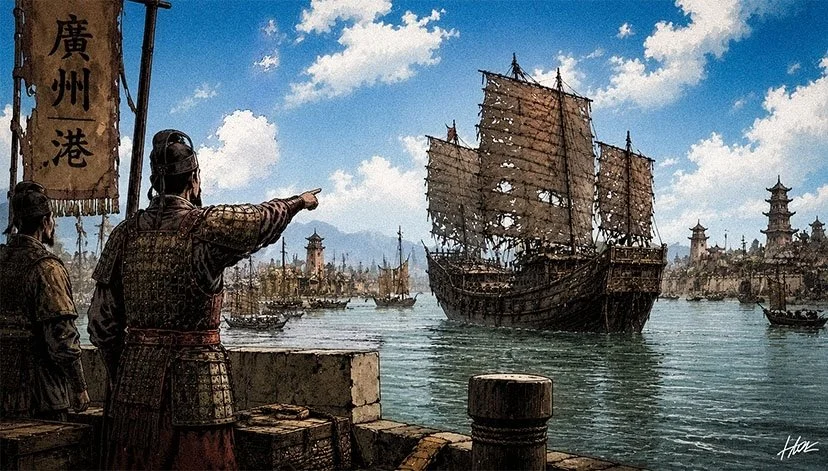
Ghost ship in the Port of Guangzhou - © 2026 Headless Horseman Productions, LLC
Not long after sailors began talking about the doomed island in the Pacific, the Black Wind reached one of the busiest ports in the eastern world. In Guangzhou, China, in the 3rd-Century, harbor guards spotted a merchant junk ship drifting slowly toward the docks at the mouth of the Pearl River. The vessel had been expected from the island trade routes weeks earlier, carrying spices, and hardwoods from the scattered archipelagos of the southern seas. But no signal flags flew from the mast. No crew moved across the deck.
When men boarded the vessel, they found most of the crew dead below deck, their bodies twisted where they had fallen during the voyage. Others stirred weakly among the cargo, rising slowly as the boarding party descended into the dim hold. The harbor erupted into panic. The infected crew were cut down quickly, and the vessel was towed back into the harbor mouth and set ablaze. Officials blamed the event on a strange sickness carried by sailors from distant islands. But word spread quietly among the seamen of the South China Sea, something terrible was traveling the trade routes.
Not every outbreak announced itself so clearly. At times, the sickness slipped ashore unnoticed. In 672, along India’s Malabar Coast, merchant ships traveling the island routes of Southeast Asia regularly stopped in the ports of Calicut and Muziris, where sailors, merchants, and dock workers crowded the narrow waterfront markets. One such vessel arrived after a difficult voyage. Several crewmen had fallen ill and died at sea. Believing it to be a common tropical disease, the surviving sailors carried the bodies ashore to be burned according to local custom.
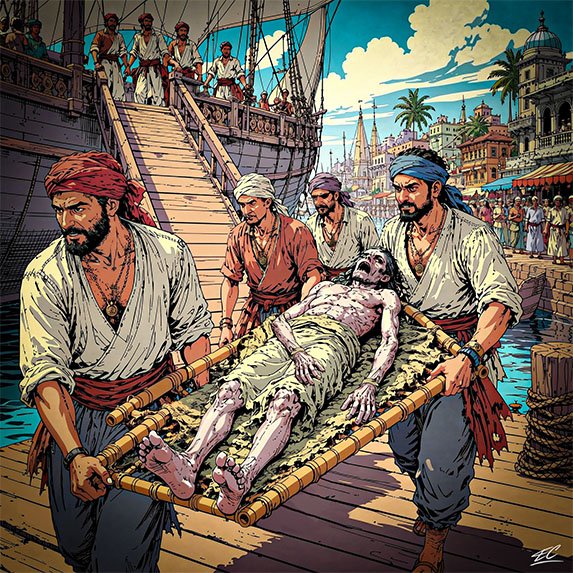
A sickness onboard - © 2026 Headless Horseman Productions, LLC
But before the pyres could be lit, the dead moved. The outbreak spread rapidly through the dense dockside districts. Entire streets were barricaded as the infected rose among the living. Though the city eventually contained the sickness, ships leaving the harbor carried more than goods. They carried fear, and the growing awareness that the Black Wind was no longer confined to distant lands.
Even as Bhekizizwe and his Slayers continued their long pursuit across the known world, whispers of the plague that once seemed like scattered outbreaks now appeared to be something far more troubling. The sickness was no longer restricted to the Fertile Crescent. They’d traced it through Egypt, North Africa, and the Mediterranean. And the stories they followed led them farther than they had ever expected.
In Spain, around 711, as Moorish armies crossed the Strait of Gibraltar and marched into Iberia, rumors spread among Christian settlements of a terrifying weapon carried at the front of certain raiding parties -- Walking dead bound in long iron chains, were unleashed upon defenseless villages. Their handlers would announce their approach with piercing cries and howls that echoed across the countryside, and the living gave them a name befitting their cruelty -- The Shepherds of Death.
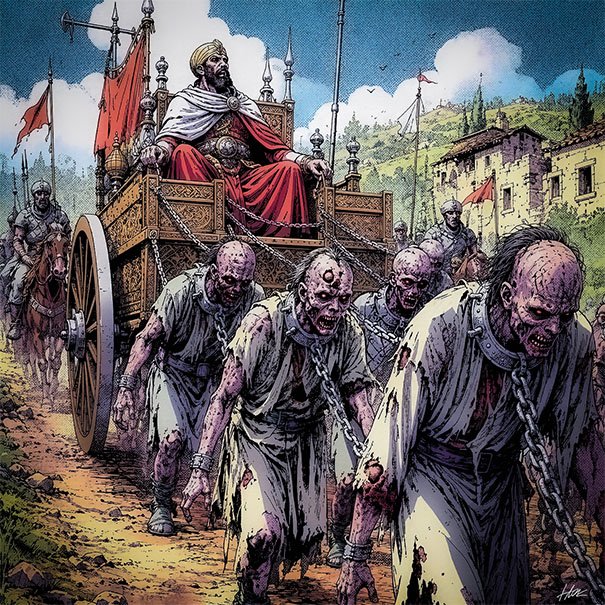
Shepherds of Death - © 2026 Headless Horseman Productions, LLC
Many villages surrendered without resistance, fearing a fate worse than death. Others were not given the choice. The Shepherds would release the chained zombies into the populace, allowing the infection to spread unchecked, before moving on...
When word of these atrocities reached Bhekizizwe, he made the Shepherds their next target. The Eternal warrior and his Slayers hunted the raiding bands through hills and valleys, delivering swift and merciless justice to those who wielded the plague with such brutality.
Before executing him, Bhekizizwe interrogated the Moorish Leader, wanting answers...
BHEKIZIZWE: You leash the dead like beasts. Who taught you such evil?
MOORISH LEADER: We didn’t summon this plague, warrior. It was brought to us.
BHEKIZIZWE: From whom?
MOORISH LEADER: A merchant vessel. Men from eastern waters sold us cages of monkeys festering with the sickness. Telling us the creatures would spread fear if loosed among our enemies...and that the dead would rise to serve us.
BHEKIZIZWE: You sent men out in the world to procure this evil?
MOORISH LEADER: No. They sell it to anyone willing to pay.
Bhekizizwe gave no reply. His gaze turned toward the distant horizon, where the sea met the sky, and in that moment he understood that the Black Wind had found a path far wider than any battlefield.
TO BE CONTINUED…