
Written By Karl White
What becomes of someone forced to witness the worst of the world? The same horrors seen again and again, with no end in sight.
After Bhekizizwe put an end to the Shepherds of Death in Iberia, he found no peace in the victory. The chained dead were destroyed, but the memory of them lingered with the Eternal warrior. He couldn’t shake the Moorish Leader’s final revelation, the plague had not simply been stumbled upon, unearthed in some cave, or uncovered in the course of a war. The Black Wind of Death had become a commodity.
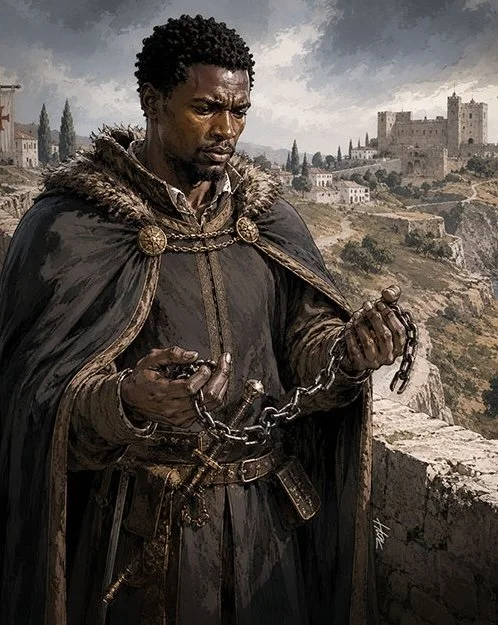
Bhekizizwe’s revelation - © 2026 Headless Horseman Productions, LLC
For centuries he hunted outbreaks as if they were storms, terrible, destructive, but isolated. A village here. A cavalcade there. A warlord foolish enough to believe he could harness the dead for labor or terror. But what he saw in Spain was beyond his comprehension. The plague was being bought and sold, and where there was profit to be made from suffering, there would always be a market.
Bhekizizwe and his Slayers turned their attention to the sea. The first years of the hunt took them south across the western Mediterranean, where merchant captains lied easily and port officials turned a blind eye, unaware, or unwilling to acknowledge, the terror passing through their harbors. Every dock had men willing to deny what they’d seen. Every customs yard had clerks who’d look the other way for silver. That’s how terrible things survive, not through secrecy alone, but through indifference.
In Ceuta, Bhekizizwe found a warehouse, hastily burned, its floors stained with old blood, its owners long gone. In Tangier, he uncovered the remains of a dockworker torn apart after opening a crate marked as exotic livestock. In Almería, he traced records of a ship that had unloaded six iron cages under cover of night, only to depart before dawn with no cargo declared and no tax paid. But the pattern repeated. The buyers vanished, the sellers disappeared...all dissolved into the endless current of commerce.
Again and again, Bhekizizwe arrived too late to do more than count the dead and read the clues of what’d happened. It was like tracking smoke across the open ocean. Worse still, the merchants seemed to have no single allegiance. That made the truth uglier. There was no crown to topple, no order to dismantle. A conspiracy could be broken. A cult could be hunted. A kingdom could be overthrown. But greed had no leader, no capital, no end.
Through the 9th-century, Bhekizizwe drove the hunt eastward along the old arteries of empire. He crossed Ifriqiya and Egypt, then doubled back into the Red Sea ports, tracing rumors from sailors who spoke of fevered monkeys packed in reed cages, their flesh already rotten in places, their eyes wild with sickness.
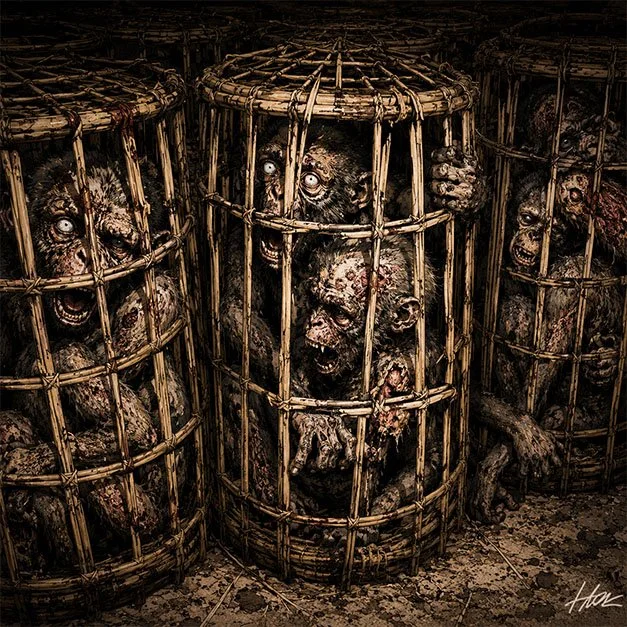
Infected cargo - © 2026 Headless Horseman Productions, LLC
In Aydhab and Berenice, he heard of corsairs who trafficked diseased animals to anyone seeking to own terror. Along the Horn of Africa, he found evidence that infected beasts were transferred to smaller vessels, then moved inland along rivers, avoiding the scrutiny of major ports.
The Slayers shadowed one such caravan for twelve days across dry country, watching from the ridgeline as traders moved their covered cages under heavy guard. At night the animals inside shrieked and thrashed themselves against iron bars, and the men tending them kept their distance, using poles rather than their hands. On the thirteenth day, just before dawn, Bhekizizwe struck. The guards were killed, the wagons burned. But the merchant-master, a narrow-faced broker, died before he could be questioned, his throat torn open by one of his own infected animals when a cage split in the fire. The trail ended once again in silence.
A grim cycle began to clear at the edge of the hunt. The merchants came from “the eastern waters”. Their cargo was said to come from island chains beyond the charts of western captains. And among older seafarers, particularly those who had spent long years crossing Pacific passages, there persisted tales of a cursed land. Yet it couldn’t be found on any map.
Bhekizizwe chased the rumor of the Island of the Dead, whenever he could, but the ocean made liars of all directions. One sailor claimed the land lay beyond the Spice Islands. Another insisted it drifted south of known routes, hidden among reefs and storms. A pirate in Aden, swore to have seen corpses standing in the surf on an uncharted atoll beneath a moonlit sky. But when pressed for bearings, his account dissolved. And so, the centuries wore on that way.
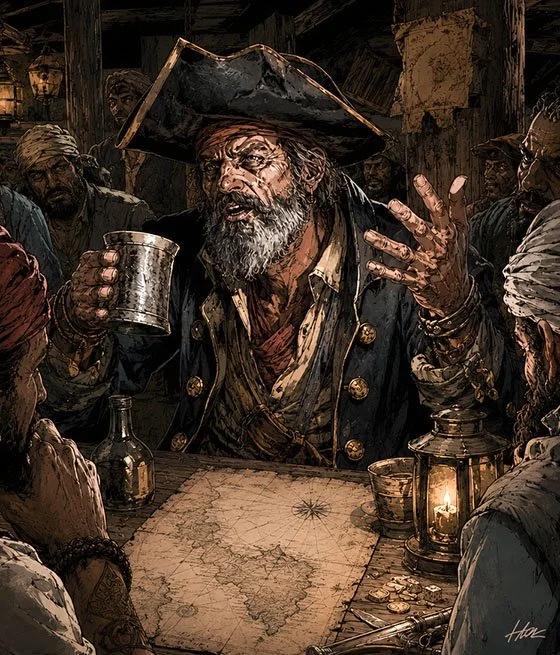
Rumors abound of the mysterious island - © 2026 Headless Horseman Productions, LLC
Yet in his travels, Bhekizizwe carried something with him beyond the hunt. He spread warnings, giving weight to a plague many still dismissed as myth. And as knowledge grew, so too did the willingness of others to speak. With caution came whispers. Mouths would open, fingers would point the way. And slowly, the path began to narrow.
In Sicily, he intercepted a shipment meant for a nobleman who wished to unleash the dead on rebellious tenants. In Crete, he hunted down two pirate brothers who sold what they called “walking punishments”. In Tunis, he arrived just in time to prevent infected animals from being loaded onto a galley bound for the western Mediterranean. In Tripoli, he learned that some buyers never intended to use the plague for conquest, but sought it for spectacle or simply because terror itself had become fashionable among cruel men.
That realization changed the nature of his war. He’d once believed if he followed the trail far enough, he’d finally uncover the hidden center of it all. By the beginning of the 17th-century, Bhekizizwe had become less a hunter of outbreaks and more a student of the system. He built caches in coastal cities. Left warning marks and coded messages for the scattered descendants of older Slayers. He paid informants in gold, ivory, and plunder taken from those who trafficked in the plague. He shadowed through the widening world, no longer chasing but trying to map a disease that had woven itself into trade, empire, piracy, and ambition.
Eternal life made him patient, but it hadn’t made him immune to loss. Men and women served beside him for years, sometimes decades, then disappeared into the plain arithmetic of mortal life. Some fell in combat, others aged beyond the fight or lost the will to continue. Each generation faded, and with it, the memory of what had come before. The Slayers had to be rebuilt again and again, their purpose carried forward by those willing to inherit the burden.
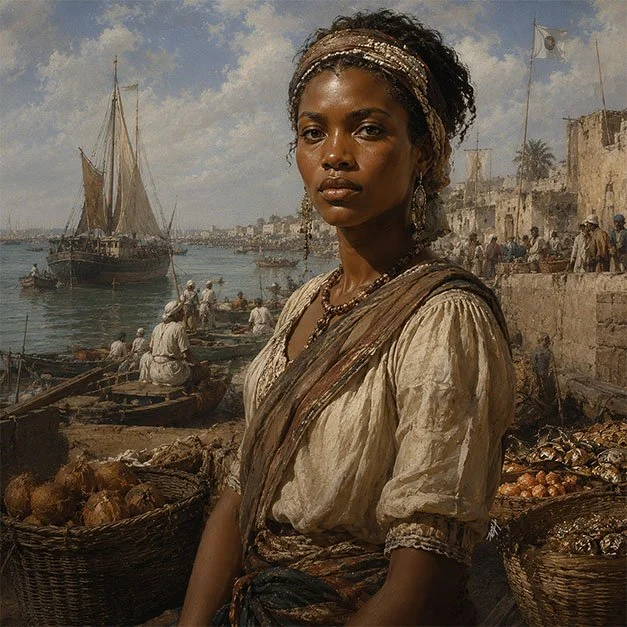
Nandi, circa 1672 - © 2026 Headless Horseman Productions, LLC
That began to change in 1672, when in a port along the Swahili Coast, Bhekizizwe encountered a young woman named Nandi. The daughter of a harbormaster, she’d grown up watching the movement of goods, understanding the hidden currents that governed trade. When her father succumbed to the plague after a trafficker brought it through the harbor, she turned that knowledge toward vengeance. She hunted down the privateer responsible and killed him, along with his crew, alone.
Nandi quickly became one of Bhekizizwe’s most trusted captains, and together they remade the Slayers into something new. No longer a band who chased outbreaks, but a network that anticipated them. Watchers of ports. Guardians of the unseen pathways through which the plague traveled.
By then, the sea lanes of the world had grown dense with movement. Charter companies governed from distant counting houses. Pirates shadowed the winds. Privateers blurred the line between commerce and war. Human beings, spices, gold, silk, weapons, and disease all moved along the same routes. The plague and it’s transmission had become part of that machinery of civilization and trade.
And so the Slayers adapted. They became detectives at the thresholds of the world. Standing not only between the living and the dead, but between humanity and those who would profit from its destruction.
For nearly a thousand years, Bhekizizwe tried to force the horrors he'd seen into darkness. But there would be no packing the old evils back into their box. What the world required was vigilance. Men and women willing to look beneath the surface, and stand guard against the terror that moved unseen.
TO BE CONTINUED…