
Written By Karl White
After the incident in Fall River, the O’Bannon brothers understood what they’d done, whether they chose to admit it or not. Though their names were never formally tied to the Borden murders, the guilt followed them. Softened only by the pull of profit.
Controversy clung to the carnival as it moved from town to town. Whispered unease trailing behind it. Rumors of a show that had crossed some unseen boundary. And still, they pressed on. The money was too good, and the crowds, drawn by morbid fascination, continued to gather.
At the center of it all, Anne Hyde continued to deteriorate. Her condition worsened with each passing week. The illusion of humanity had long since faded. Flesh sagged and tore, her features collapsing into something grotesque and unnatural. The brothers reinforced her restraints, layering heavier chains and enclosing her within a thicker cage, widening the distance between her and the living. They shortened the act, tightened their control, adjusted the illusion. But nothing could conceal what she’d become, a living embodiment of decay and hunger. And for many, that only deepened the draw.
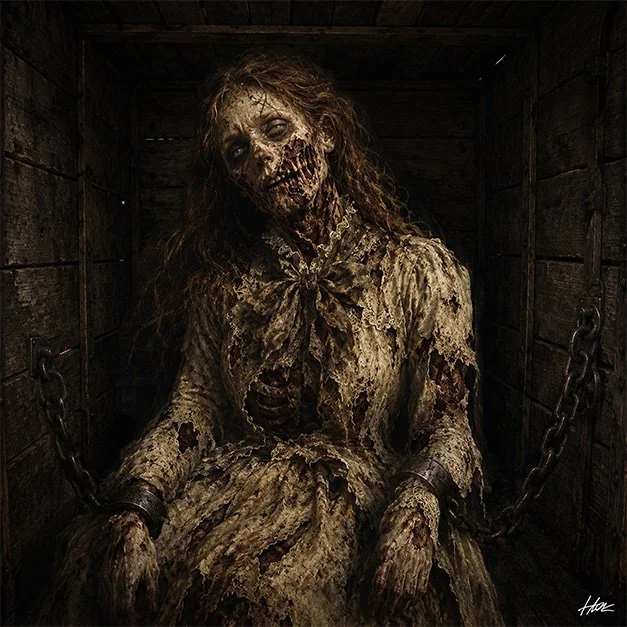
The deterioration of Anne Hyde - © 2026 Headless Horseman Productions, LLC
By the time the caravan reached the American South, word of the “Living Dead Girl” preceded them. In some towns, the show was met with curiosity. In others, with outright hostility. Preachers warned congregations of a traveling abomination, a defiance of God’s natural order. Groups gathered in protest. In a few places, stones were thrown, threats shouted from the back of crowds. The O’Bannons adapted as they always had, moving quickly, staying long enough to profit, then disappearing before tensions could boil over...But they couldn’t outrun what was coming.
Just outside the small town of Holcombe, Kentucky, their caravan was stopped along a narrow stretch of wooded road by a gathering that had already turned into something more dangerous than a protest. A group of local Baptists, stirred by rumor and fear, came not to watch, but to put an end to what they believed was evil incarnate. The confrontation escalated quickly. Wagons were overturned, performers scattered, and the cage at the heart of it all was torn open.
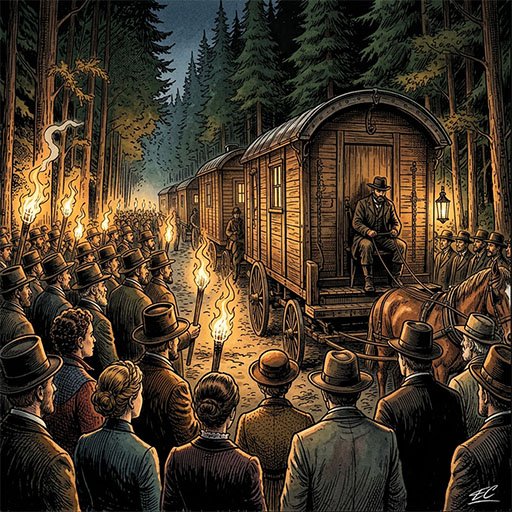
Confrontation in the hills outside of Holcombe, KY - © 2026 Headless Horseman Productions, LLC
When Anne was pulled out, the crowd recoiled in horror. Whatever they expected to find, it was not this. There was no illusion left, no showmanship to soften the reality. She was something broken, something wrong with the world, something that shouldn’t exist...heartbreaking to some, as how could anyone exploit a poor innocent girl, albeit, a dead one. The O’Bannon brothers tried to reason with them, claiming she was no longer human, but a miracle of life itself, continuing on after death. But the mob had already made its decision.
The brothers were dragged to the edge of the forest, beneath a tall oak tree. Rope was thrown over branches, nooses tightened, and the brothers were hanged before the gathered crowd. Anne was strung up beside them, her body left to sway in the still air. But as the minutes passed it became clear -- what is already dead, isn’t easily killed again.
Fear turned to fury. They cut her down and shots rang out as members of the mob fired into her body again and again, until at last whatever unnatural persistence remained, ceased. Desperate to end it, they buried what was left in a shallow grave on the outskirts of a primitive cemetery.
But those who had handled the body, or lingered too close, soon fell ill. A small outbreak followed, ravaging the town. Though quickly quelled, the damage had been done. And so, as often with inexplicable things in religious communities, it was never spoken of again...and for a time, that seemed to work. Yet the ground where Anne was buried, changed. Something endured there, waiting beneath the surface.
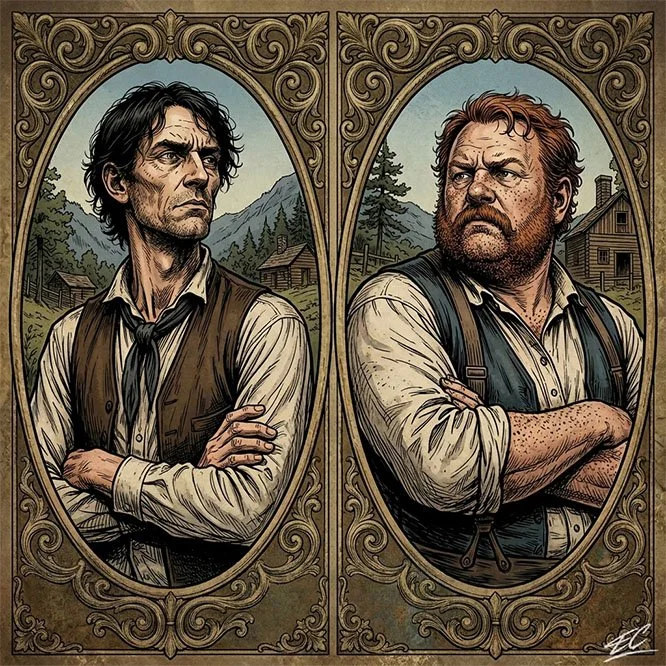
A bitter conflict (left to right - Colville and Murphy - © 2026 Headless Horseman Productions, LLC
Two years later, in October of 1894, tensions in the region were already strained. The echoes of the Hatfield-McCoy feud still lingered across eastern Kentucky, and disputes over land and resources were common, often escalating beyond reason.
In the hills near Holcombe, a bitter conflict took root between neighbors, Elvin Colville and Henry Murphy. At the center was a stretch of land neither side was willing to concede.
What began as discord hardened into resentment, then quickly devolved into open hostility. The men spoke less and watched more, each convinced the other would make the first move. It did’t take long before that expectation became reality. During a confrontation along the disputed boundary, tempers flared and a shot was fired. It was meant for a man, but struck a child. Seven-year-old Ruth Colville died before nightfall.
The grief that followed was immediate and consuming. By lantern light Elvin buried his daughter, placing her in an old family plot just beyond the settlement...unaware the soil he chose had already been touched by something unnatural.
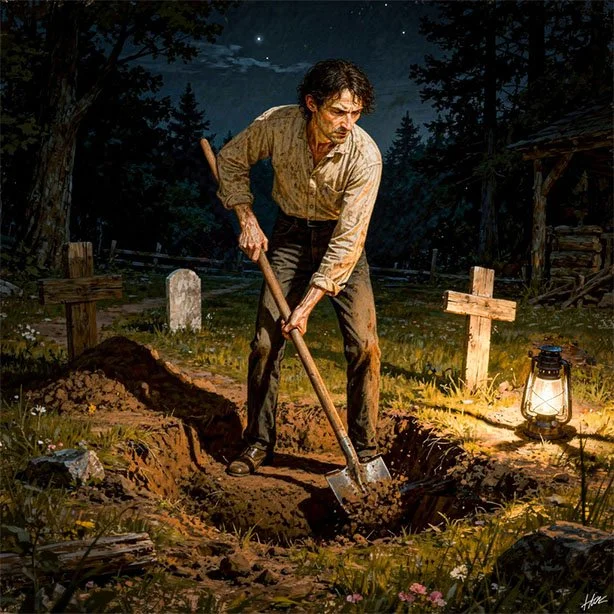
Burial in curse ground - © 2026 Headless Horseman Productions, LLC
Days later, the earth gave her back. But Ruth didn’t rise as she’d been. Driven by something her decaying mind no longer had the capacity to understand. She staggered in a familiar direction. When Elvin saw her at the edge of the trees, there was a moment, a fragile, desperate hope she’d somehow survived and came home. But the illusion shattered almost instantly, as whatever returned was not his daughter.
In the tragic chaos that ensued, Elvin’s wife Clara, rushed from the house at the sound of her husband’s cries. Seeing the silhouette of the little girl, Clara hurried to be reunited with their daughter -- but was attacked. Elvin rushed in, forced to put his reanimated daughter down. Clara’s wounds seemed minor at first, overshadowed by shock and sorrow. But by the following day, the sickness had taken hold. She also turned, and Elvin was forced to end her life as well.
Grief gave way to rage. Elvin turned his anger toward the Murphys, placing blame where it had long been waiting to settle. The conflict that’d already claimed his daughter and his wife now demanded more. He acted without restraint, killing one of Murphy’s sons, Theo, in a sudden act of violence.
Theo was buried quickly, downstream from the same corrupted ground that held Ruth and Clara. By nightfall, the pattern repeated. What followed was not a feud in the traditional sense, but something far worse. Each death fed the next. Each burial became another beginning. The dead did not remain where they were placed, and soon the distinction between attacker and victim blurred.
Family members turned on one another. Those who fell rose again. Those who tried to defend themselves became part of the same cycle. The violence and horror kept neighbors from leaving their homes. As the infection spread not just through violence, but proximity.
Towards the end, it wasn’t about feuding anymore. Elvin Colville went crazy and killed the last of the walking dead, then turned the gun on himself. Seventeen lives were lost in all. But death was no longer the end of the story.
When local authorities arrived, they found a situation far beyond their control. State officials were called. Within a day, federal forces and units of the United States Army sealed off the region under strict orders. The bodies were burned. The homes were destroyed. The land was cordoned off. Records were suppressed, witnesses silenced, the truth buried beneath official accounts.
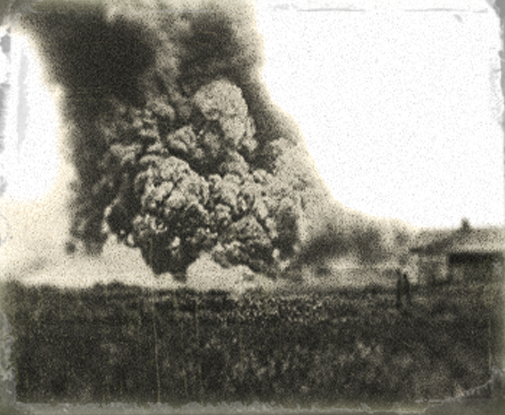
Authorities burning bodies after the Colville and Murphy incident, 1894. Courtesy, Holcombe County Historical Society - © 2026 Headless Horseman Productions, LLC
But memories don’t yield so easily. Aldo Addams, the son of a nearby landowner, would later recount what he saw in a radio interview years after the fact.
ALDO ADDAMS: Don’t know much about the feud, I’s thirteen when it happened. Started in the summer, I ‘member that. My daddy later told me it was on account of an improper survey and fight over where their claims ended. Murphy wanted us to get involved, but daddy wouldn’t. It was scary, a lot of yelling and arguing, everyone was on edge. Things turned bloody. A lot still bothers me, when I think back. It may sound strange. I saw Colville’s daughter, Ruth, get killed and I know for a fact she was dead. Days later...I don’t know how to put it...but she came back. So did some of the others. A lot of ‘em died, but they’d show up again. We couldn’t make heads or tails of it.
Official reports quickly reduced the event to a localized conflict, exaggerated by rumor and fear. But not everything was destroyed. Before the area was burned, a smaller group arrived. Men who didn’t wear uniforms or concern themselves with the living or the dead. They moved through the site with purpose, collecting soil, preserving samples. Unbeknownst to those involved, the Black Wind crossed another threshold.
It would now be studied...in the hands of men who believed they could understand it, control it, and wield it for something they called “the greater good”.
TO BE CONTINUED…