
Episode 90: Doctor Ichikawa
Written By Karl White
Sometimes a weapon, once taken up by the right hands, becomes something greater than what it was ever meant to be.
As time passed, the slow-acting plague of the Black Wind of Death, remained for the most part, unchanged. There were mutations, of course. Some strains produced corpses that moved with greater speed, others with heightened violence or erratic behavior, but the underlying nature of the sickness held steady. Transmission was consistent, incubation predictable. For all its horror, the virus was limited. It could be contained, even anticipated. But that fragile balance wouldn’t last.
In the early twentieth century, a figure would emerge who looked upon the Black Wind not as a pestilence, but a disruption of biology itself. And in attempting to unravel its mystery, would reshape the virus into something far worse.
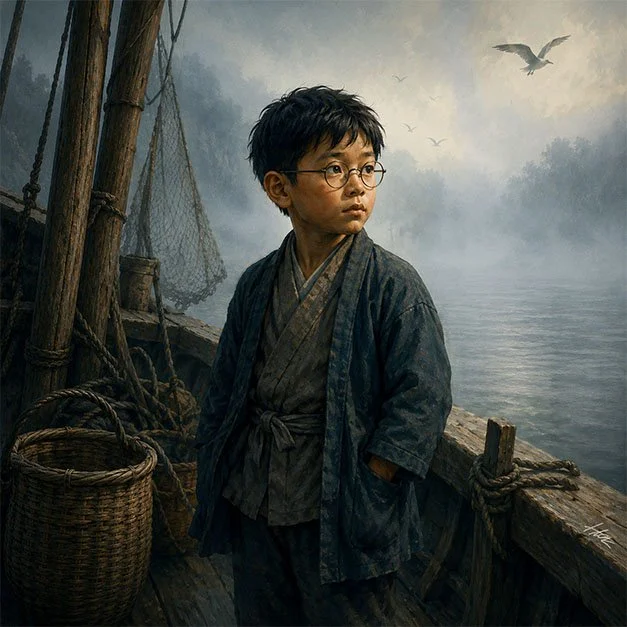
Haruki Ichikawa, aged 7 - © 2026 Headless Horseman Productions, LLC
The story began in 1905, in the cold waters of Ishikari Bay, Japan, when seven-year-old Haruki Ichikawa witnessed the event that’d define the course of his life.
His father was a fisherman, and on occasion Haruki would tag along. It was an ordinary morning, shrouded in fog, until something appeared through the haze. An American steamship, drifting without purpose, silent and without signs of life. Curiosity and concern overcame caution, and the two boarded the vessel, unsure of what they'd find.
Below deck, they discovered confusion and death. Bodies lay scattered in unnatural stillness, yet in the shadows, some moved. They fed on what remained of the others. The sound of the Ichikawa's approach drew the attention of the infected, and in an instant, the stillness gave way to violence.
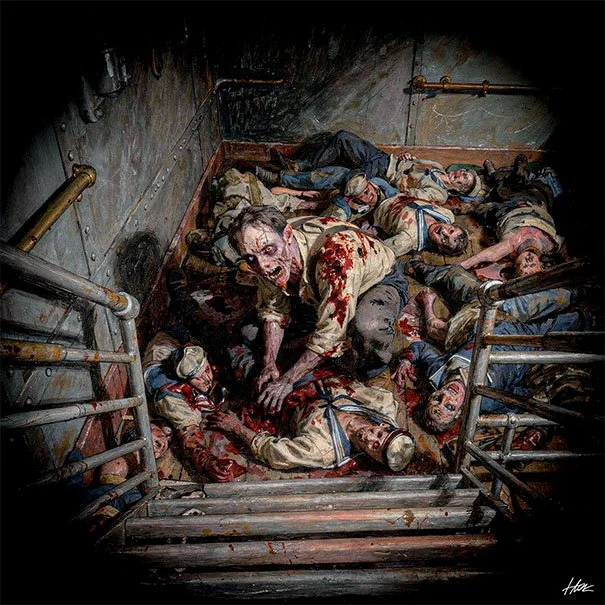
Terror below deck - © 2026 Headless Horseman Productions, LLC
Young Haruki fled back to the deck in terror. But his father didn’t make it.
HARUKI’S FATHER: Haruki, go! Get help!
The boy watched as he was dragged below, disappearing into the darkness, consumed by something that wore the shape of men, but had lost all trace of humanity.
Back in the fishing vessel, by the time Haruki reached shore, he could barely speak. Fishermen found him wandering in the shallows, soaked and trembling, his words broken by shock. His fragmented account was enough to alert the Imperial Navy. A cutter was dispatched, and what the soldiers found aboard the drifting ship confirmed the story in full.
There was no attempt to recover bodies, no effort to investigate. The vessel was burned where it floated, the flames consuming whatever remained within. As whatever was aboard could not be allowed to reach land. The incident was quietly buried, recorded in sparse detail and filed away.
Haruki was placed in quarantine for over a month, isolated from the world as authorities attempted to determine whether he’d been exposed. In that confinement, the events replayed endlessly in his mind. The ship, the dead, his father dragged below...and a tortured implication of what came after.
But sometimes what frightens us most gives way to curiosity. A need to understand, to confront what seems unknowable. Haruki became consumed not only with what he’d seen, but what it meant. And in the quiet of his thoughts, another detail took root. Though no official record confirmed the ship’s origin, he knew the vessel was American...And from that knowledge, a seed of resentment grew, shaped by grief and the need to assign blame to something beyond himself.
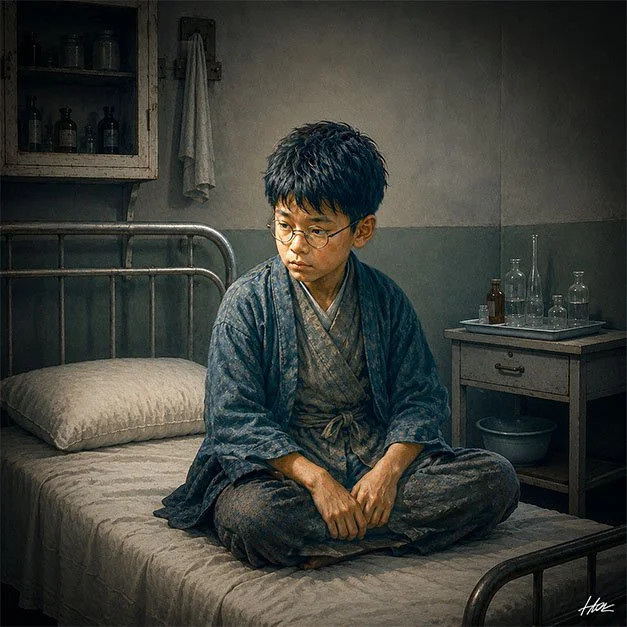
Grief taking hold - © 2026 Headless Horseman Productions, LLC
Sixteen years later, Haruki Ichikawa graduated from Tokyo Imperial University with a doctorate in medicine, his studies focused heavily on infectious disease. He entered military service soon after, where his intelligence and discipline quickly brought him to the attention of senior leadership. By 1927, he’d become a trusted medical advisor to Field Marshal Viscount Uehara Yūsaku, a position that granted him both influence and access.
Through careful persuasion, Ichikawa framed his interests in the Black Wind not as obsession, but necessity. The Spanish Flu pandemic had ravaged humanity in 1918. The world was on edge over the topic of disease. Warfare was also evolving, and with it, the nature of threat. If this plague were somehow released against Japan, the nation would be defenseless. To understand it was not merely academic, but strategic. If it could be studied, the advantage would be immeasurable. His argument was accepted, and he was granted the authority to pursue his research, so long as it served the interests of the state.
His objective was to understand the virus, and develop a cure. But the only specimens he could get ahold of to advance his research were decayed, degraded versions of rotted flesh from ancient outbreaks. What he needed was a fresh sample of the Black Wind.
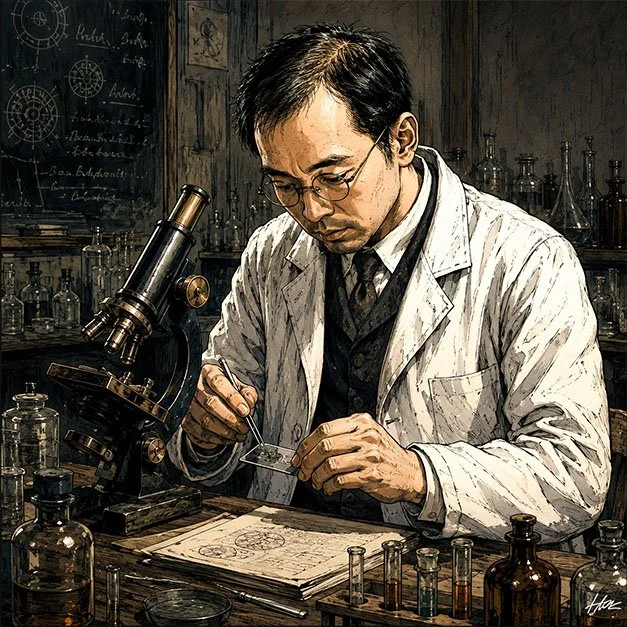
Studying plagues - © 2026 Headless Horseman Productions, LLC
The problem was the plague had all but vanished from open trade. The networks that once trafficked in it had been dismantled by Bhekizizwe and his scattered order of Slayers. Ichikawa turned to the black market, but his position as a man of science made him suspect among those who dealt in such things. His inquiries led nowhere.
But throughout history, the Dark always had a way of finding those seeking the malignant. As Ichikawa’s search faltered, an answer arrived unbidden. A letter from an English physician named Bellian Vale, who claimed to have learned, through indirect channels, of Ichikawa’s interests. Vale offered knowledge of a place dismissed by most as myth, an island in the South Pacific where the dead did not remain buried.
Ichikawa accepted. An expedition was assembled, and a small team set out in search of the Island of the Dead. At sea, Ichikawa found himself drawn to Dr. Vale. He was cultured, articulate, and carried the ease of old wealth. A man of science, or so he appeared. But Vale was the demon Ba’el in a modern form. Where once he’d come as a prophet, mystic, or advisor, now he came as something the modern world trusted, a scholar. The age of superstition had given way to reason, and so the demon adapted, offering not myth, but truth.
After a difficult journey, the expedition found the island. It was real. And what Ichikawa discovered surpassed even his expectations. The dead did not simply linger there. They endured. The environment itself sustained them, preserving the sickness in a way no other place on earth could.
Deep within the island, beyond the shoreline and dense jungle, they found a stagnant bog, thick with decay and heavy with the stench of rot. It was there Ichikawa believed the plague persisted in its purest form. Not as a passing infection, but as something rooted, stable, and enduring -- the source. Vale encouraged this belief, feeding Ichikawa’s fascination, presenting the discovery as the find of the century. But it was another step guided by the Dark, steering fate.
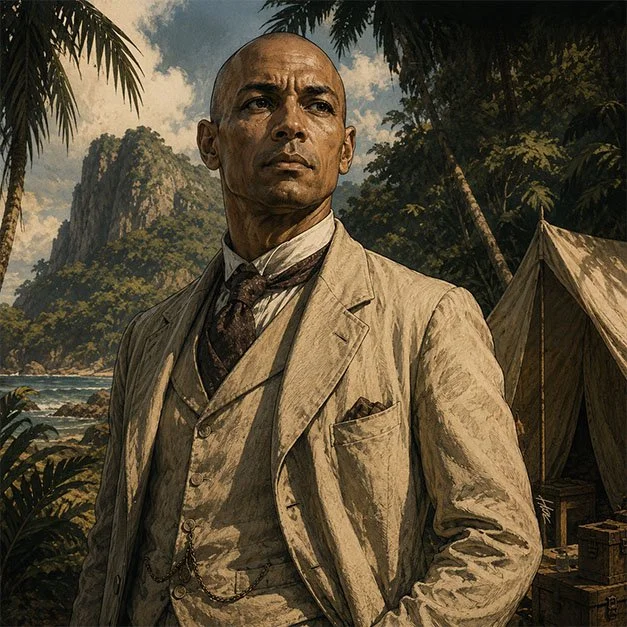
Dr. Bellian Vale, on the Island of the Dead - © 2026 Headless Horseman Productions, LLC
The pursuit to push the plague was about more than just death and destruction, as a Procession was tied directly to the Black Wind.
DEATH: “As the forgotten name spread the great plague by way of the sky, the end would begin.”
And as with all of the prophecies linked to the end of mankind, its meaning was obscured, interpretation uncertain. But every movement and choice brought it closer to providence. And so Vale pointed Ichikawa towards the plague in any way possible, hoping his future would somehow intersect with the Procession and enact the Dark’s endgame.
During their exploration of the Island of the Dead, Ichikawa came across another fascinating piece of history. Among the scattered remains of those who’d come before, he found a weathered journal, preserved against all odds. It belonged to none other than Anne Hyde.
Her writings, though fragmented, detailed the early stages of infection, and her own descent into something she couldn’t comprehend. For Ichikawa, it was invaluable. A firsthand observation. Data drawn from a lived experience.
With samples and a specimen carefully secured, the expedition departed the island. From the stern of the vessel, Ichikawa watched as the mysterious landmass faded into the horizon. What began as a boy’s need to understand the force that had violently stolen his father’s life, would now set a course that would reshape the fate of the plague itself.
TO BE CONTINUED…