
Episode 91: Burma
Written By Karl White
Some pursuits begin with honest intentions, born out of curiosity or the quiet hope of mending what’s been broken. But some paths drift, uncovering consequence, and eventually darkness. For in seeking to unravel the nature of death, one may come to reshape it, and once that knowledge is touched, it doesn’t fade. It lingers, waiting for hands willing to carry it further, long after the purpose that first gave rise to it has been forgotten.
For nearly a decade, Dr. Ichikawa worked with the virus. Operating in a gray site in a Japanese puppet state in northeastern China, he and Dr. Bellian Vale were granted near-total autonomy to pursue their research.
But what started under the guise of scientific inquiry quickly devolved into something far more insidious. Ichikawa realized a sickness as old as language might be hard to eradicate...so understanding the virus became paramount, from there other possibilities blossomed.
Thousands of prisoners, Chinese civilians, Mongolian nomads, Russian expatriates, were brought into the facility and used as living test subjects. Ichikawa studied everything from transmission rates, to incubation periods, neurological degradation, and behavioral patterns of the infected. Nothing was off limits. To him, the plague was not a tragedy waiting to happen, but a system to be examined, refined, and ultimately directed.
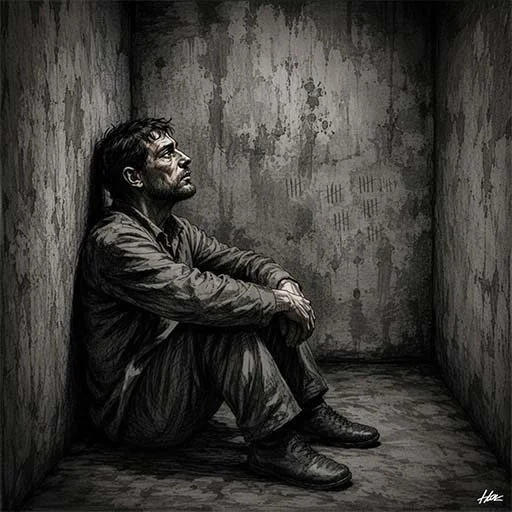
Sergei Antonov’s confinement - © 2026 Headless Horseman Productions, LLC
Among those taken was a Russian immigrant, Sergei Antonov, who’d been living quietly in northern China. He was detained without explanation, transported under guard, and delivered to the facility with dozens of others. Sergei spoke little Japanese and only fragments of Mandarin, leaving him isolated even among fellow prisoners. He was placed in a narrow cell, one of many, where time faded into a cycle of silence, distant screams, and the steady echo of boots in the corridor. Each day, guards would open a door somewhere down the line, and another prisoner would be taken away. None ever returned.
When Sergei’s turn came, it was without warning. He was marched through a series of passageways and into an enclosed yard, shadowed by high concrete walls. At first, Sergei saw nothing. Then the gate on the far side opened. What emerged had once been a man...but was now a creature running only on primal instinct.
The attack was immediate and merciless. Ichikawa watched from above behind reinforced glass, recording every detail with clinical precision as Sergei fought against his zombie attacker. But the experiment didn’t end there. Sergei was restrained, isolated, and monitored as the infection took hold. Each stage was documented, the fever, confusion, the erosion of identity, and finally, the loss of self.
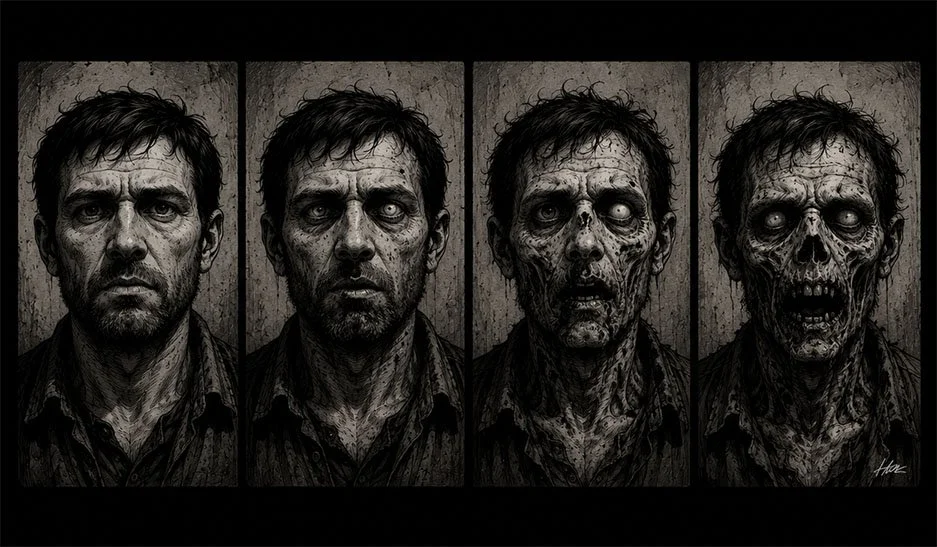
Documented progress from days to weeks - © 2026 Headless Horseman Productions, LLC
Sergei, and countless others, became the foundation of the data Ichikawa presented to his superiors. The conclusion was, the plague could be evolved. He could increase replication speed, make the virus more virulent, and ultimately weaponize it.
By 1938, intelligence of Ichikawa’s work began to reach Western powers. Reports from French and British sources described a Japanese program experimenting with a pathogen capable of reanimating the dead. The United States, uncertain of the validity but unwilling to ignore the possibility, began its own work with the plague. Using soil samples collected decades earlier from Holcombe, Kentucky, the site of the Colville-Murphy incident, American scientists initiated what became known as Project Easter.
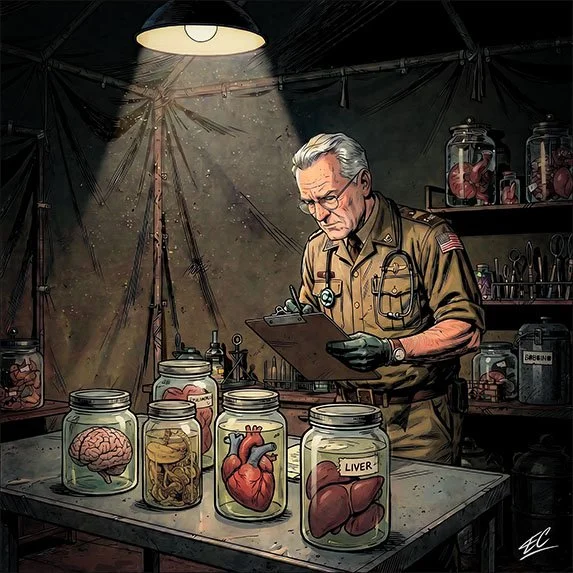
Dr. Clarke progressing through Project Easter - © 2026 Headless Horseman Productions, LLC
Led by Dr. Vincent Clarke, the program sought to determine whether the illness could be understood. Clarke’s findings were immediate and alarming. The virus was unlike any known disease, defying conventional biological limits. Within months, he concluded weaponization would be catastrophic beyond control, and strongly advised against further experimentation for medical or military purposes.
Officially, the project, like Ichikawa’s original intent, began with a search for a cure. But as with many such programs, the line between research and application obscured. In 1943, as World War Two was already underway, and after determining that no possible cure could be developed with existing methods, Project Easter was formally shut down...
Unofficially, the work continued. Under a classified initiative known as Project Salvage, the U.S. military experimented with reanimation of already deceased soldiers, attempting to use the infected as tools for detecting landmines on the European front. The logic was simple, if morally indefensible, if the dead could be used to trigger explosives without risking additional lives, then why not?
The program remained highly-classified until it was discovered the body of a prominent senator’s son had been used in testing. Threat of public exposure forced an immediate shutdown. Records were sealed or destroyed, and the official position of the United States government became clear and unwavering -- the virus never existed. But it was a denial that wouldn’t hold.
Amid the global conflict, Ichikawa’s work advanced beyond anything attempted elsewhere. The refined pathogen, now referred to within military circles as the Haruki Strain, marked a turning point. But one problem remained, deployment. He was seeking scale and a method of transmission that could overwhelm entire populations before containment was even possible. But early iterations, while deadly, were too slow, too visible, too easy to isolate once discovered. Ichikawa needed something invisible.
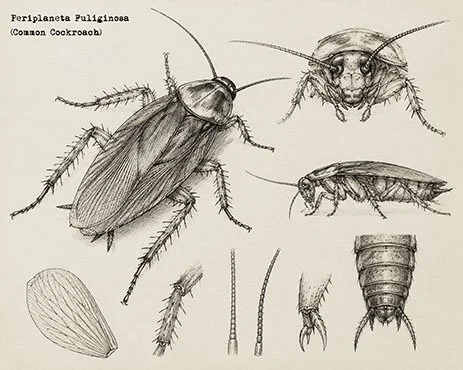
Searching for a vector - © 2026 Headless Horseman Productions, LLC
Drawing inspiration from the spread of the Black Death in the 14th-Century, he turned to vectors, fleas, cockroaches, and other vermin capable of moving undetected through dense populations. These carriers could infiltrate camps, cities, entire regions without warning. Infection would begin long before symptoms appeared, ensuring maximum spread before any response could be organized.
The first large-scale field test of this method took place in Burma in 1944. A British encampment was compromised without a single shot fired. Within hours, soldiers began to fall ill. By the time the nature of the outbreak was understood, it was already too late. Confusion spread faster than the infection itself. Men turned on one another and the camp collapsed into chaos. That’s when a distress call was sent out.
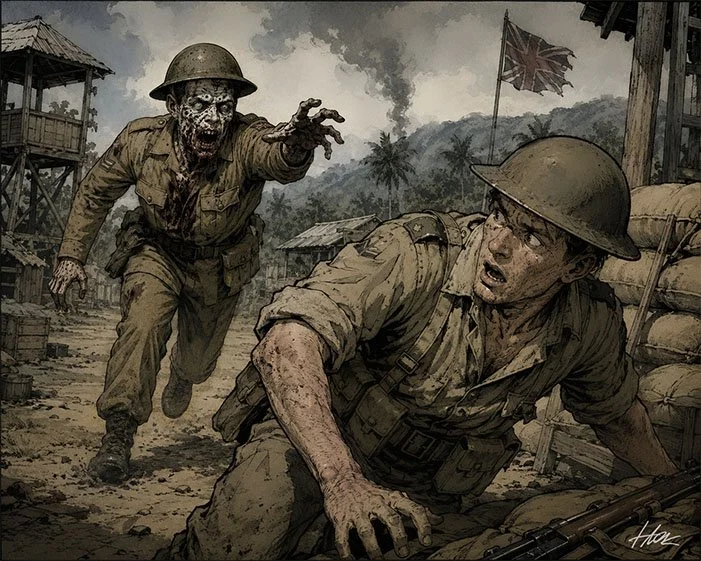
Outbreak in Burma - © 2026 Headless Horseman Productions, LLC
BRITISH OPERATOR: Mayday, Mayday, this is Redford. Something’s wrong. We’re overrun. Unknown contagion has compromised the camp. Requesting immediate support. Advise extreme caution...
The U.S. Marines were deployed. And among them was a young officer named Lawrence “Larry” Halford, an emerging leader with a background in biology from Colorado State University. He arrived with no understanding of what awaited him, but what he encountered would define the rest of his life.
Amid the mayhem, Halford witness something that should not have been possible, dead soldiers, rising, feeding, moving without life behind their eyes. He gave the order to eliminate the reanimated...
LARRY HALFORD: Open fire!
In the aftermath, when it became clear the outbreak had been engineered and spread deliberately, Halford immediately petitioned his superiors for permission to investigate the source. His academic background made him uniquely suited to confront what others could not understand. The request was granted. Intelligence briefings soon followed, and for the first time, Halford was exposed to the full scope of what had been unfolding for years -- Ichikawa’s experiments, other reports from the war, and the abandoned research of Project Easter.
From that moment forward, Halford’s focus became singular. He began to assemble the fragments into a single, terrifying picture. A plague few knew existed, a system already in motion, and at its center, a man refining it. A doctor shaping the death into something purposeful, with America in his sights.
TO BE CONTINUED…