
Episode 92: Horrors of War
Written By Karl White
There are those who carry burdens no one else knows exist. Standing in the quiet spaces between catastrophe and normalcy. Intercepting threats before they’re named, or even believed. Their work is never celebrated, because it cannot be acknowledged. And to those few who understand the stakes, their purpose borders on the divine. Because if they fail, we’ll only know when the world unravels.
Larry Halford was one of those people. In the eyes of the few within the United States government who understood the true nature of the threat, he was the thread holding it all together. While the world’s attention remained fixed on conventional warfare and the race for atomic power, a quieter fear was spoken behind closed doors.
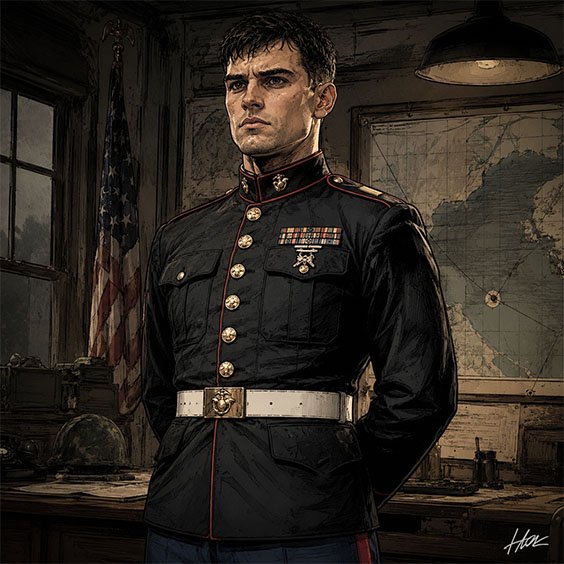
Larry Halford joins the fight - © 2026 Headless Horseman Productions, LLC
Reports from the Pacific, fragments of intelligence from allies, and the scattered accounts of outbreaks, all pointed to the same conclusion. The Japanese had developed something far more sinister and destructive than any single bomb. And having seen the effects with his own eyes, of what the plague could do, Halford understood, this front of the war required a foresight.
Assigned to the Office of Strategic Services, Halford was placed in command of a small, specialized task force. Their mission was not to fight a war in the traditional sense, but to prevent a large-scale biological attack like the Japanese had in mind.
At his side was Roy Starling, a man who had also faced the aftermath of Dr. Ichikawa’s handiwork in Burma. During the Marine response, Starling, then an Army tank gunner, abandoned his Sherman, rescuing two wounded men before zombies advanced on their position. He had a reputation for running headlong into situations most avoided. So where Halford brought intellect and obsession, Starling brought instinct and resolve. Together, they worked in the shadows of official operations, chasing rumors and fragments, trying to stay ahead of a catastrophic attack.
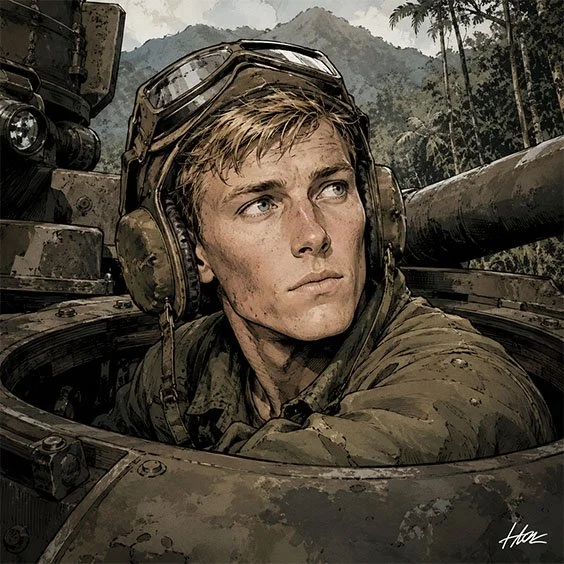
Roy Starling, Halford’s right hand - © 2026 Headless Horseman Productions, LLC
But even as Halford fought to stop the plague, he uncovered something far more troubling. His own government was not entirely aligned with his purpose. The same intelligence that exposed Ichikawa’s work had also inspired imitation. After the death of Dr. Vincent Clarke, killed in an accident during a classified test, his research from Project Easter did not disappear. It was quietly transferred to another scientist.
Dr. Charles Wahl recognized the potential of a pathogen capable of reshaping warfare. By combining remnants of Project Easter with samples recovered from Ichikawa’s work in Burma, he pushed the plague beyond anything previously attempted. The result was a variant with accelerated mutation and rapid replication, a strain designed not simply to spread, but to wholly overwhelm.
Testing followed in 1944, in the small farming town of Mattoon, Illinois. Residents reported a mysterious assailant, quickly dubbed the “Mad Gasser”, who released a vaporized version of the plague into homes through windows and doors. Within hours, victims experienced confusion and paralysis, before dying and reanimating to become violent zombies, driven solely by primal instincts. The test with the gas version was a success, reaching a 100% infection rate.
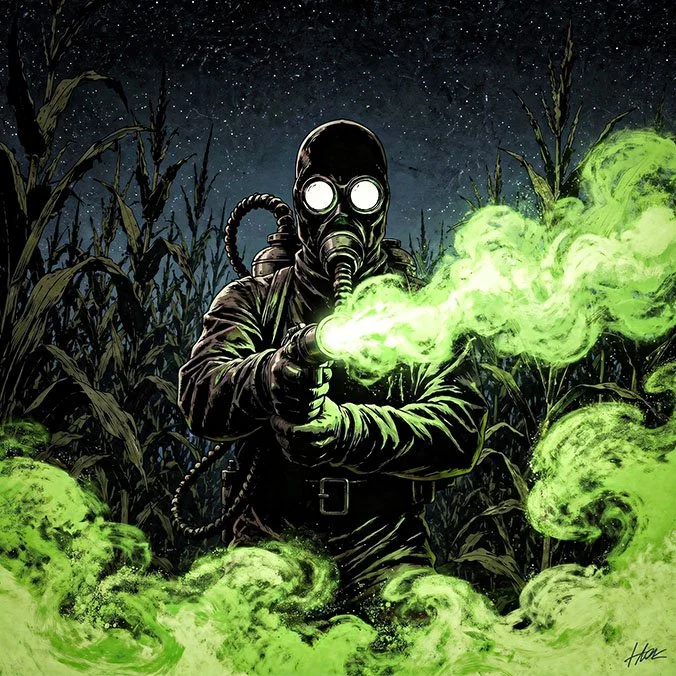
The Mad Gasser of Mattoon, Illinois - © 2026 Headless Horseman Productions, LLC
Though containment of the dead and eradication of the active virus proved far more difficult, as even wildlife carried it quickly beyond initial points of exposure. Wahl’s variant was eventually deemed “too effective” in communicability. Its potential was too catastrophic for practical deployment. It was classified as a “Doomsday Contingency”. Yet even so, liquefied forms of the pathogen were preserved and stored in case the possibility that such a weapon might one day be necessary.
While Halford and Starling objected to what Wahl was doing, they had no control over military objectives. Their position was a paradox. They were tasked with stopping Ichikawa, while others within their own government ensured that the United States would not fall behind should such weapons be used against them.
While Halford pursued answers at home, events overseas were approaching a breaking point. In 1945, Ichikawa’s work had reached a level of refinement that made large-scale deployment not only possible, but imminent. The Haruki Strain had been tested, adjusted, and proven effective. Japanese military leadership, desperate to shift the tide of the war, began preparing for its wide-spread use against Allied forces. But history intervened.
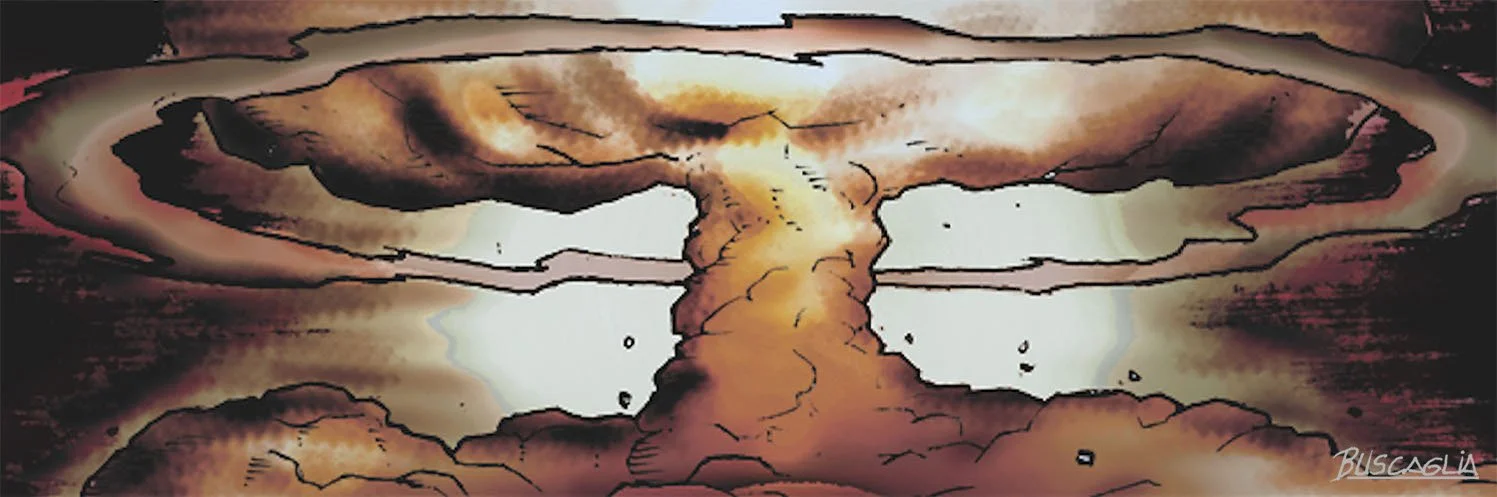
Unimaginable destruction - © 2026 Headless Horseman Productions, LLC
In August of ‘45, atomic bombs were dropped on Hiroshima and Nagasaki, unleashing destruction beyond anything the world had ever seen. What few understood was Hiroshima housed one of the largest stockpiles of Ichikawa’s work -- infected cockroaches, prepared for utilization. But the blast didn’t destroy them all.
In the days that followed, as the city struggled to comprehend the devastation, a second horror began to emerge. Survivors spoke of figures moving through the ruins, burned, broken, yet still walking. At first, they were mistaken for the injured. But as reports spread, the truth became undeniable. Among the living, something else had taken hold. The dead were rising.
Special military units were dispatched under strict secrecy to contain what remained of the outbreak. Among them was Lieutenant Miko Takahashi, a decorated officer who volunteered for the mission few expected to survive. His entire family had been in Hiroshima when the bomb fell. For Takahashi, the assignment was no longer duty, it was all that remained.
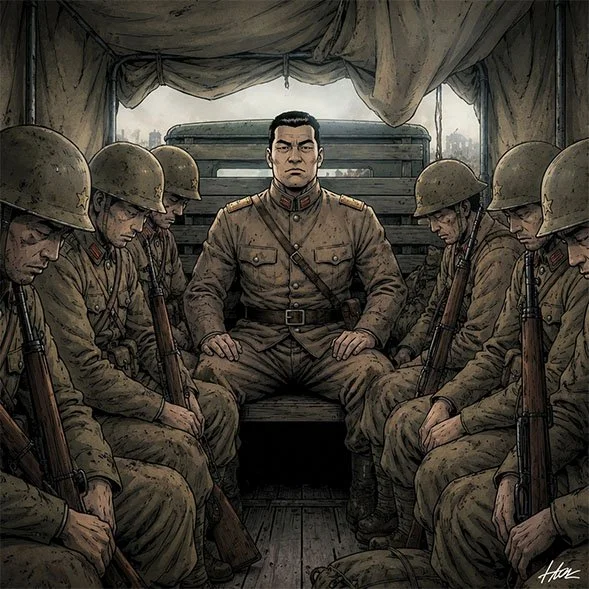
Sent on an impossible mission - © 2026 Headless Horseman Productions, LLC
What his unit encountered defied comprehension. The devastation of the blast was already beyond anything they’d prepared for. But the presence of the infected turned it into something even more nightmarish. Medical camps became feeding grounds. Survivors were forced to turn on those they’d tried to save. Entire sections of the city had to be cleared not just of the dead, but of those who refused to stay that way.
Takahashi and his men were forced to destroy what had once been their own people, often at close range and without hesitation, for fear of death or worse. They worked to evacuate those still untouched, but confusion and grief made cooperation difficult. Families, already shattered by the bombing, could not understand why soldiers were turning their weapons on the wounded. Resistance was common. Panic was constant.
By the time the reports reached Allied intelligence, the full scope of what had been unleashed began to take shape. For Halford, it was confirmation of his worst fears. This was not a theoretical threat. But one turned loose in the aftermath of one of the most devastating events in human history. The line had been crossed.
And worse still, it had been crossed by more than one side.
Halford came to understand that his fight was no longer just against Ichikawa. It was against an idea, one that had taken root across nations, across governments, by men who believed they could control something that had never fully been contained.
In the shadows of a world struggling to rebuild, Halford and Starling continued their work. The war, as the public understood it, had ended. But for them, the real battle had only just begun.
TO BE CONTINUED…