
Episode 93: Blue Moon
Written By Karl White
In 1945, the great war was ending, and the world sought to stitch itself back together. For most, the worst had passed. But beneath the promise of peace, something lingered...
In the aftermath of Hiroshima and Nagasaki, as Japan faced total surrender, Dr. Haruki Ichikawa disappeared. Confronted with the certainty of arrest and court-martial, he fled the collapsing remnants of the Empire, carrying with him years of research and the refined plague he’d come to believe was mankind’s reckoning.
When Allied forces demanded his capture as part of the surrender terms, it was already too late. Ichikawa had vanished, and with him, the most dangerous weapon the war had never officially seen.
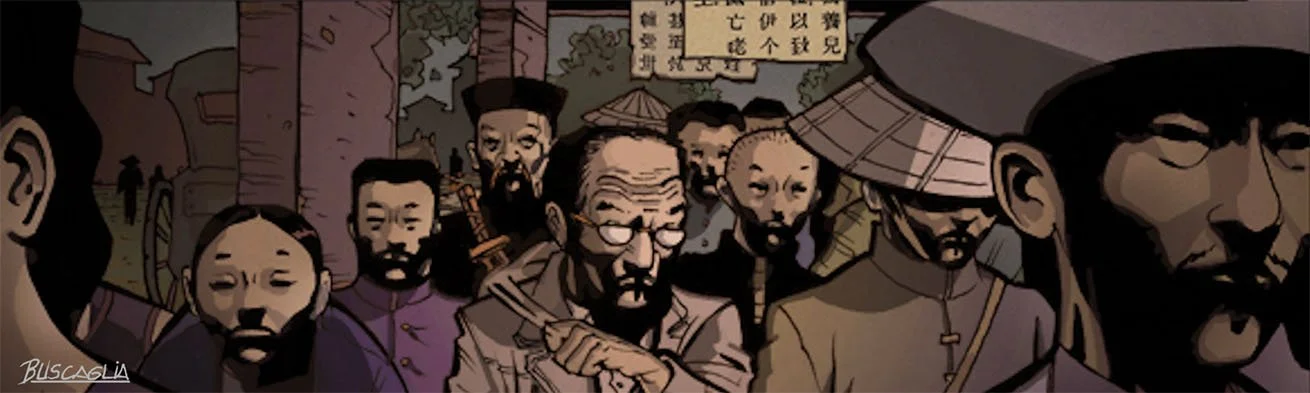
Ichikawa flees Japan - © 2026 Headless Horseman Productions, LLC
The search that followed spanned continents. And at its center was Larry Halford. Leading the manhunt with relentless focus, he pursued Ichikawa across Europe and Asia, piecing together fragments of intelligence that grew colder with each passing month. The war had ended, but Halford understood that the fight would not be done until the doctor was found.
With the backing of Dr. Bellian Vale, Ichikawa retreated to the remote reaches of the Kamchatka Peninsula in Russia. A place far removed from scrutiny, where the shifting lines of post-war borders provided cover for what remained of his work. There, he gathered a small cadre of loyalists, former pilots unwilling to accept surrender. Many had lost everything and had nothing left to return to. And Ichikawa offered them purpose and a promise in one final act of retribution.
Together, they planned an attack on American soil. A covert operation to release plague-infested fleas over the United States in the hopes of creating a massive zombie outbreak to radiate across the country. To the men who followed him, it was vengeance, a symbolic answer to the devastation of the atomic bombs.
In May of 1947, aboard a misappropriated Japanese aircraft carrier that had slipped unnoticed through the North Pacific, battered planes were loaded with crude canisters filled with thousands of infected fleas. Before the pilots departed, Dr. Ichikawa joined them below deck, delivering a final message.
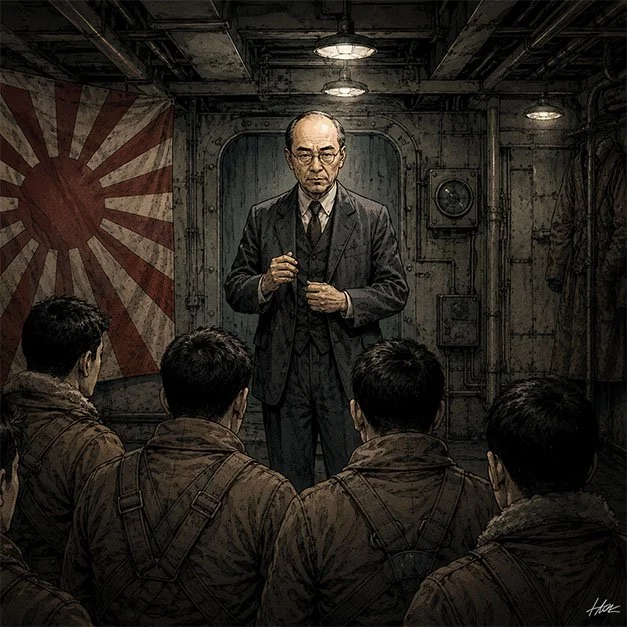
Dr. Ichikawa addresses the mission - © 2026 Headless Horseman Productions, LLC
DR. ICHIKAWA: We’ve all suffered great losses. I, too, lost someone important at the hands of America. Nothing dulls that pain. But we will show them, the Empire surrenders to no one. Tonight, is a revenge long overdue...
Their intended target was San Francisco. But to avoid detection, the squadron flew most of the journey without radio or navigation, relying on dead reckoning -- navigating based on time, speed, distance, and direction, nothing more. But flying in formation with damaged equipment, through poor visibility and shifting winds, their course began to drift. Without a reliable fix, each mile carried them farther from where they believed they were.
Near midnight, and running low on fuel, the pilots, spotted land. In the distance, what lay before them was not San Francisco, but the small coastal town of Blue Moon, situated in southwest Oregon...not their target, but a suitable enough place to release death.
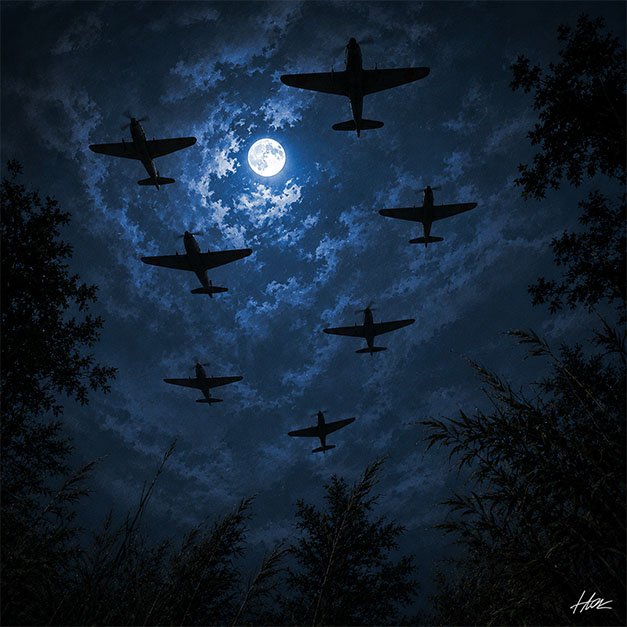
Approaching Blue Moon - © 2026 Headless Horseman Productions, LLC
75-year-old Ernie Tanner, heard them first. He was part of a small group of patriotic volunteers who’d spend their nights monitoring for unusual signals, at the local radio station in Blue Moon. A duty born from years of coastal anxiety during the war. Pearl Harbor was the major catalyst, along with close calls in San Pedro, California in ‘42, Brookings, Washington in ‘43, and Salmonberry, Oregon in ‘45. Despite the war having ended two years prior, fear of what the open ocean could bring, was still very real.
At 12:11 a.m., through static and interference, Ernie heard voices speaking rapidly in Japanese. The only word he could make out was “tagetto”, which meant “target”. He quickly placed a call to the nearest National Guard outpost, sixty miles away.
But from the sky the planes began to fall. All compromised. Three released their payloads before crashing. One struck farmland just outside of town. Two hit within Blue Moon itself, one on the main street, another just a block away. The others scattered across the surrounding wilderness. The damage was immediate. But the true disaster had yet to begin.
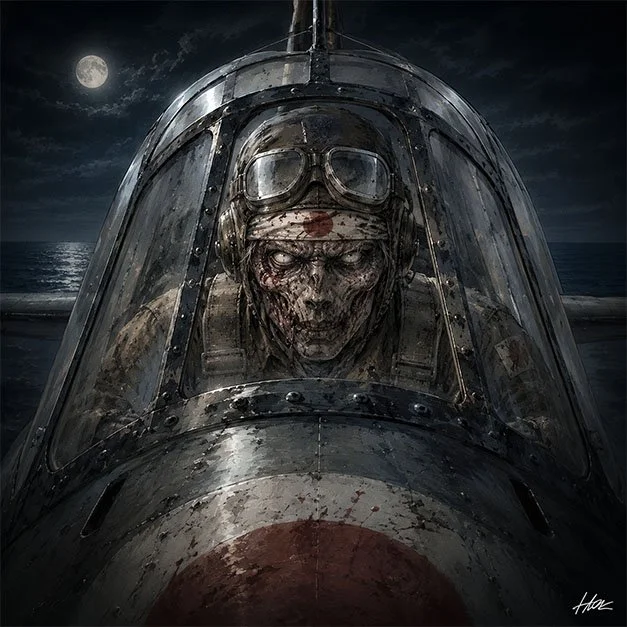
Compromised pilots - © 2026 Headless Horseman Productions, LLC
From the wreckages, the infection spread. Several pilots had already been exposed mid-flight, their containment compromised before they ever reached land. Those who survived the crashes did not remain survivors for long. They rose quickly, violently, attacking anyone who came near.
First responders, drawn by the sound of impact, arrived with no understanding of what they faced. They were among the first to fall. Fleas distributed, scattered into the surrounding areas, finding new hosts to infect. Curious onlookers, townspeople drawn to the wreckage, became part of the chain. Within an hour, the first wave of illness took hold. Within two, the dead began to rise.
By the time the National Guard arrived, Blue Moon was already collapsing. The local hospital was inundated, becoming an epicenter for the virus’ spread. Small pockets of violence radiated outward, house by house, street by street. Families turned on one another. Police were overwhelmed. No one understood what they were facing, only that it couldn’t be stopped through conventional means. Though it was not the densely populated target Dr. Ichikawa had intended, the virus performed exactly as designed.
By 5 A.M. Eastern Time, word reached Washington D.C. Thirty minutes later, Larry Halford was airborne. Roy Starling, already on the West Coast, was moving north before the order had even fully reached him.
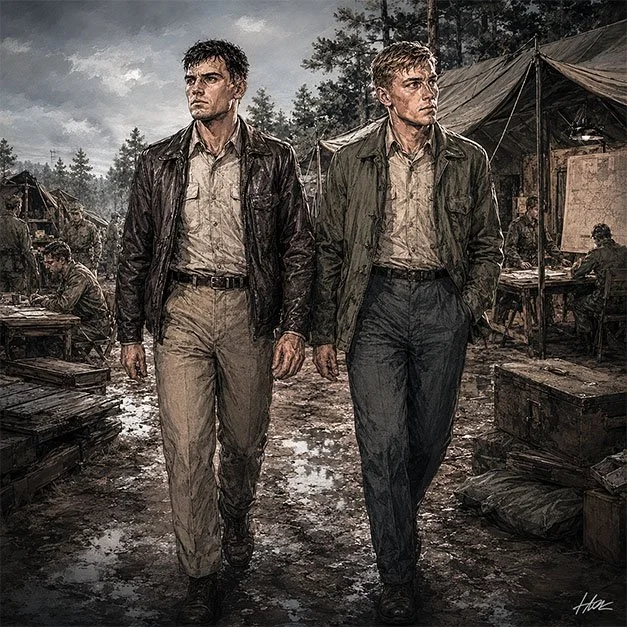
Halford and Starling arrive - © 2026 Headless Horseman Productions, LLC
They arrived to something both men had thought about, but hoped would never happen. A perimeter around the town had been established, but it was failing. Gunfire echoed through the hills. Smoke drifted from scattered fires. And within the town, the dead were going after anything that moved.
Halford and Starling made their way through the forward command, gathering reports, speaking with shaken officers, piecing together what exactly happened. Like Burma, the pattern was unmistakable. Vector dispersal, rapid infection, immediate breakdown of structure. There was no doubt, it was Ichikawa’s handiwork.
The decision came quickly, but not without weight. The mission had always been to stop something like this before it happened, to prevent exactly this kind of outcome. But the truth in front of Halford was undeniable. From their vantage point they could see survivors, fighting for their lives. But the risk of rescue was too great. If even a handful of infected slipped through the perimeter, if the plague reached the highways, rail lines, neighboring towns...there’d be no way to stop it.
There would be no evacuation. No exceptions. The town had to be erased. What followed was swift and absolute. Artillery was brought into position. Fire was then used where bullets failed. By the time it ended, Blue Moon was reduced to ash and silence. Whatever had begun there, ended there.
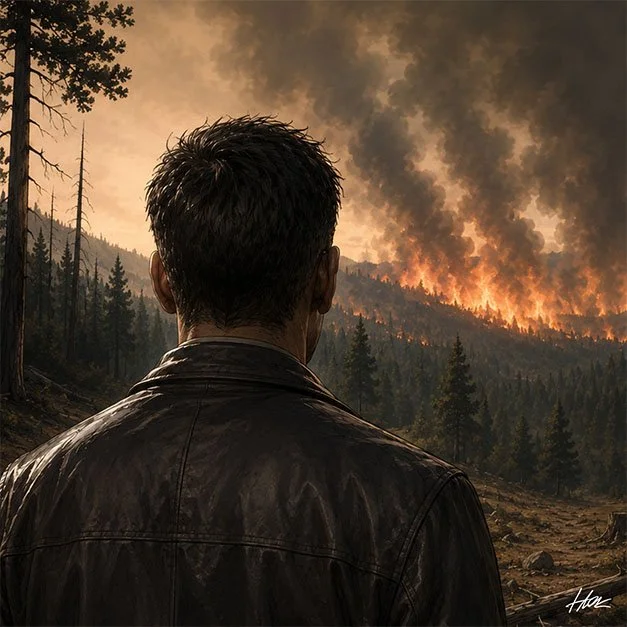
Larry Halford watches Blue Moon burn - © 2026 Headless Horseman Productions, LLC
As with Holcombe, Kentucky, and countless other outbreaks, the official record of what took place, was concealed. The memory of Blue Moon would fade into obscurity, and the world never knew how close it’d come to the edge of annihilation.
For Larry Halford, he’d made difficult calls before, war demanded that, but those decisions were carried by the shape of conflict. This was something else entirely. The justification was clear and the outcome unavoidable -- if the infection escaped, the cost would have been immeasurable. But Halford, for the first time, felt the weight of a decision that could never be defended, only lived with.
But his fight was no longer about stopping something before it happened, but deciding how far one was willing to go when it could no longer be contained. Hesitation by anyone else would have meant collapse...and it was then he knew, his mission had to be to erase this plague from existence once and for all.
TO BE CONTINUED…