
Episode 94: Manhunt
Written By Karl White
Following the contained outbreak in Blue Moon, Oregon, Dr. Haruki Ichikawa was once again in the wind. No intelligence agency or foreign military had even the faintest trace of his movements. But he resurfaced far from scrutiny, in a quiet fishing village along the coast of Fiji, living under an assumed identity, his appearance diminished, but not his ambition.
To the outside world, he was a whisper. But in isolation, with limited tools and dwindling resources, he continued his work. Refining what remained of his research with the same obsessive precision that defined him from the beginning.
His failures had cost him the favor of Dr. Bellian Vale, as well as whatever loyalty remained among his countrymen. By 1950, his money had run dry. What remained were four vials, four fragments of the plague he’d spent his life perfecting. And so, for the first time, Ichikawa did something he’d long resisted, he sold sickness to anyone willing to pay. Three of the four vials were quietly transferred through back channels into Soviet hands. The plague reentered circulation, uncontrolled, and far more dangerous because of it.
The Soviets, eager to explore any advantage in the growing tensions of the Cold War, wasted little time. During the Korean War, isolated attempts were made to deploy the virus against Allied forces, though the results were inconsistent and often poorly executed.
Though in 1951, one such incident produced a record that would later find its way into Larry Halford’s files. Australian pilot Colin Kinstrey, shot down deep in contested territory, managed to activate a field recorder as he awaited rescue. What was captured was not combat, but something far more disturbing...
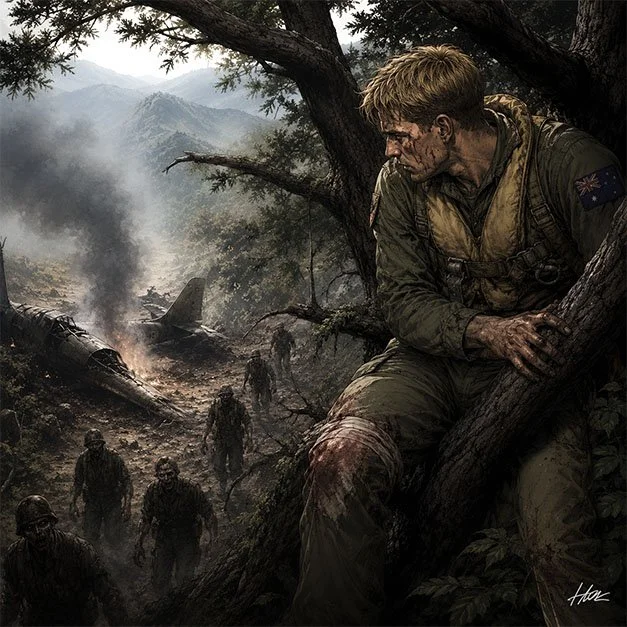
Pilot Colin Kinstrey waits for rescue - © 2026 Headless Horseman Productions, LLC
KINSTREY: I was able to pull myself clear of the wreck...but my leg’s definitely broke. I’ve made it into a tree...awaiting rescue…There’s six of ‘em down there now. Enemy troops, I think, but something’s not right. They’re moving slow...not looking at the aircraft. No reaction to the crash. They’re not searching, they’re sniffing…They’ve got me scent...Their eyes, Christ, they’re not right. Strewth...they’re coming! Mad as a cut snake, climbing...
When the rescue team arrived, all they found of Kinstrey were some bloody scraps of clothes and the recording he’d made. A firsthand account of what the Soviets had begun to experiment with.
Other reported cases from the war were minor and easily contained because of the harsh terrain and inclement weather in which the poorly planned attacks took place. Leaving the Russians little to show for their effort. But intel on the attacks fueled the search for Ichikawa, helping Halford prove to the powers-that-be, the doctor was still active.
Over the next decade, Ichikawa, continued his work on the lamb, stretching his last vial of plague as far as he could. With fewer constraints and less time, his research took on a narrowed, sharper, and more desperate edge. What emerged was an extremely volatile version of reanimated death. Dubbed the Crimson Virus, it was unlike earlier strains, which stripped away higher function and reduced the infected to instinct alone. This version left fragments of cognition intact. The result was not mindless hunger, but something far more chaotic, confusing, and rage-filled. Fractured awareness trapped within a body driven to kill.
Untested on humans, it was offered at a discounted price. Ichikawa wanted to get the virus into circulation, feeling as though his days were numbered.
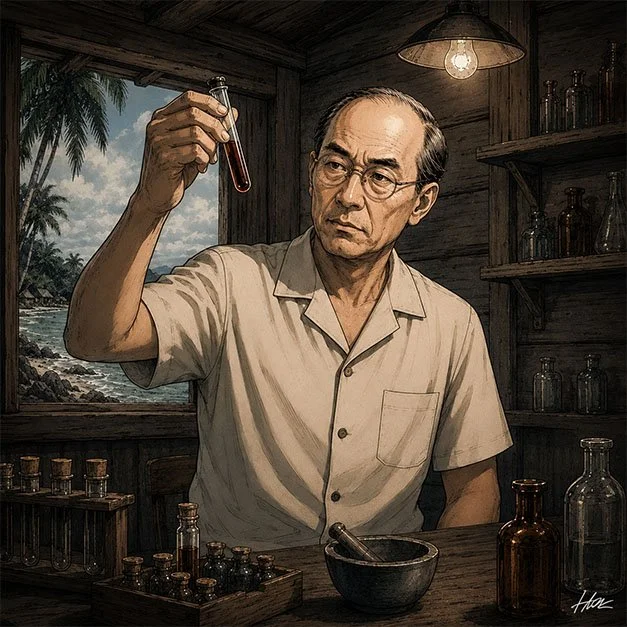
Ichikawa and the Crimson Virus - © 2026 Headless Horseman Productions, LLC
One of his first buyers was Salim Al-Hamdani, the son of a wealthy oil baron and leader of a paramilitary faction known as the Nar Ittihad, The Fire Union. Driven by ideology and resistance to growing Soviet influence in his native Syria, Al-Hamdani sought a primitive weapon to destabilize his enemies quickly and without warning. The Crimson Virus would provide the necessary means for his plans...
The introduction of this new strain of plague into the Middle East didn’t result in immediate catastrophe, but in something slower and more insidious. But that was the Dark’s plan all along. As in a territory already strained by political tension, the presence of such an archaic force only deepened the instability, seeding conflicts that would echo for decades.
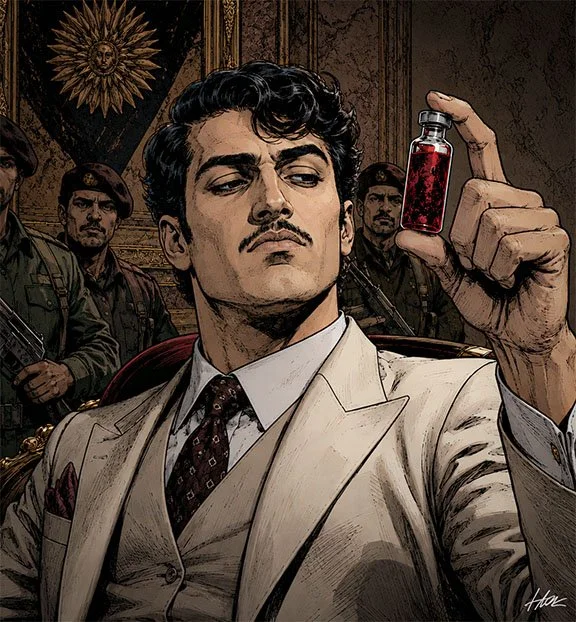
Salim Al-Hamdani and the means to stop his enemies - © 2026 Headless Horseman Productions, LLC
Half a world away, Larry Halford faithfully remained on the hunt for Ichikawa. His mission never wavered, no matter how cold the trail grew. Alongside Roy Starling, he dismantled remnants of the doctor’s work wherever they surfaced, often arriving just in time to prevent small outbreaks from becoming something far worse. It was a war of attrition fought in silence, against an enemy who rarely left a trace.
But a monumental break came in 1961. Soviet physician, Tamir Duskin, defected to the United States, bringing with him intelligence that confirmed the Soviet experiments with the virus. And most importantly, he’d been in recent contact with Ichikawa in Hong Kong -- so after years of near-misses, Halford moved immediately.
The operation was swift, but not without risk. Halford believed Ichikawa would not hesitate to use the virus to protect himself, so the approach would require precision and control.
He and Starling led the team, tracking the elusive doctor to a refugee-heavy settlement where he’d begun preparing yet another departure. When they found him, he didn’t run or resist, he simply looked at Halford as though he’d been expecting him all along.
For Larry, there was no triumph in the moment. Only the quiet recognition between two men who’d spent years moving toward one another from opposite ends of the same path. But he did believe, for the first time in a long time, the threat was truly diminished, as the man who’d shaped the modern plague was finally out of the equation.
In the States, a secret trial followed, conducted in cooperation with the Japanese government. Charges of war crimes were brought against Ichikawa, and the evidence, though never made public, was overwhelming. He was found guilty on all counts. Before his execution was to be carried out, Larry Halford was granted one final meeting to try and extract any useful intel.
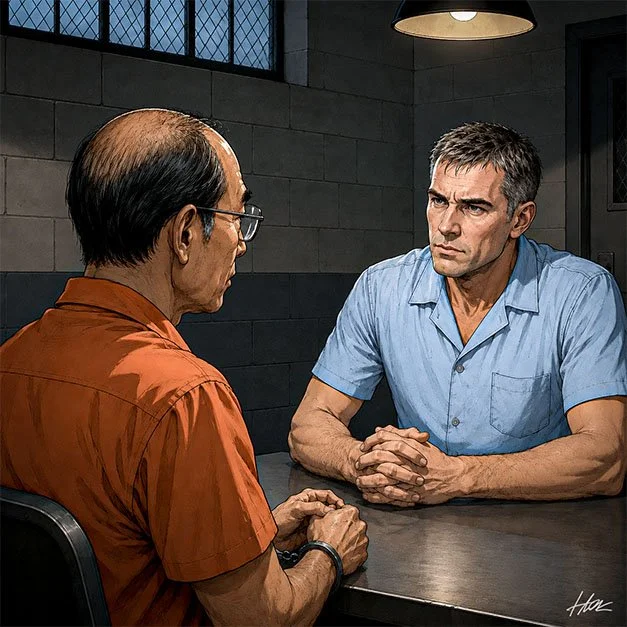
Final conversation - © 2026 Headless Horseman Productions, LLC
The conversation wasn’t recorded, but what Halford carried from it would shape everything that followed. Ichikawa told his story, and spoke not of regret, but of inevitability. Claiming the plague never belonged to him, that he’d only revealed what mankind would eventually discover on its own.
And before the meeting ended, Halford gleaned one final useful piece of information, the name of Ichikawa’s partner -- Bellian Vale.
Dr. Haruki Ichikawa was executed on November 17, 1962, at Fort Leavenworth, Kansas. His death was not announced. The world at large would never know his name, or the scope of what he’d done. But the damage he’d wrought could not be undone. Because by the time Halford closed the door on Ichikawa, the most dangerous form of the plague had already been set loose.
And somewhere in the world...others were learning how to use it.
TO BE CONTINUED…